As we all were celebrating yet another remarkable edition of Chicago Jazz Festival, continuing a tradition since 1979, I found myself
looking at the event through the lens of alternate timelines, putting time in perspective and zooming in and out on the journey this thing called jazz continues taking us on.
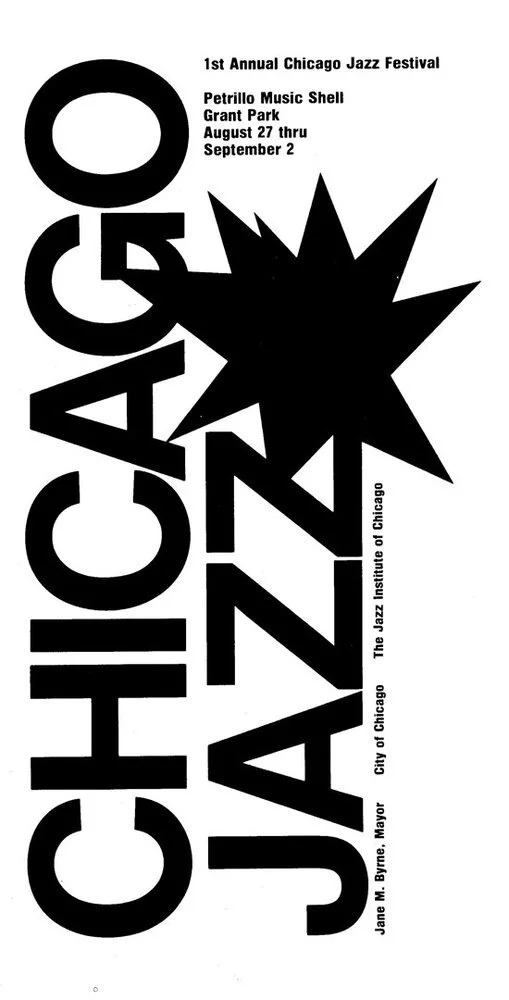
What was that first Chicago Jazz Festival like? An Ellington Night, a Coltrane Night, and five more programs assisting a week-long celebration of music at Grant Park.
Today, 47 festival editions later, the program in Millennium Park looks ironically familiar.
As Paul Marinaro is delivering a selection of Ellington’s finest tunes topped with his warm baritone and animated stage presence, I turn to my colleague Kathy D. Hey, a lifelong Chicagoan, my solid festival partner in crime, and say: “It’s amazing that music has this magical capability to be an emotional catalyst, to take you places in just a matter of seconds.” “Oh yeah,” nods Kathy, and we both get transported to one of those equally legendary and fancy Manhattan jazz clubs in the 1960s.
Zooming out again, my memory takes me across the ocean to my old textbooks I found last summer at my parents’ home, with academic notes on Coltrane and Ellington my teenage perfectionist self left in impeccably rhythmical handwriting. This year marks 15 years since my first Chicago Jazz Festival experience; I landed here back in 2011, so please forgive my sentimental mood. Zooming in again, I bring my attention back on stage, still processing the quantum leap between that teenage self and the jazz journalist I am today. Time, what a weird construct of the human mind you are.
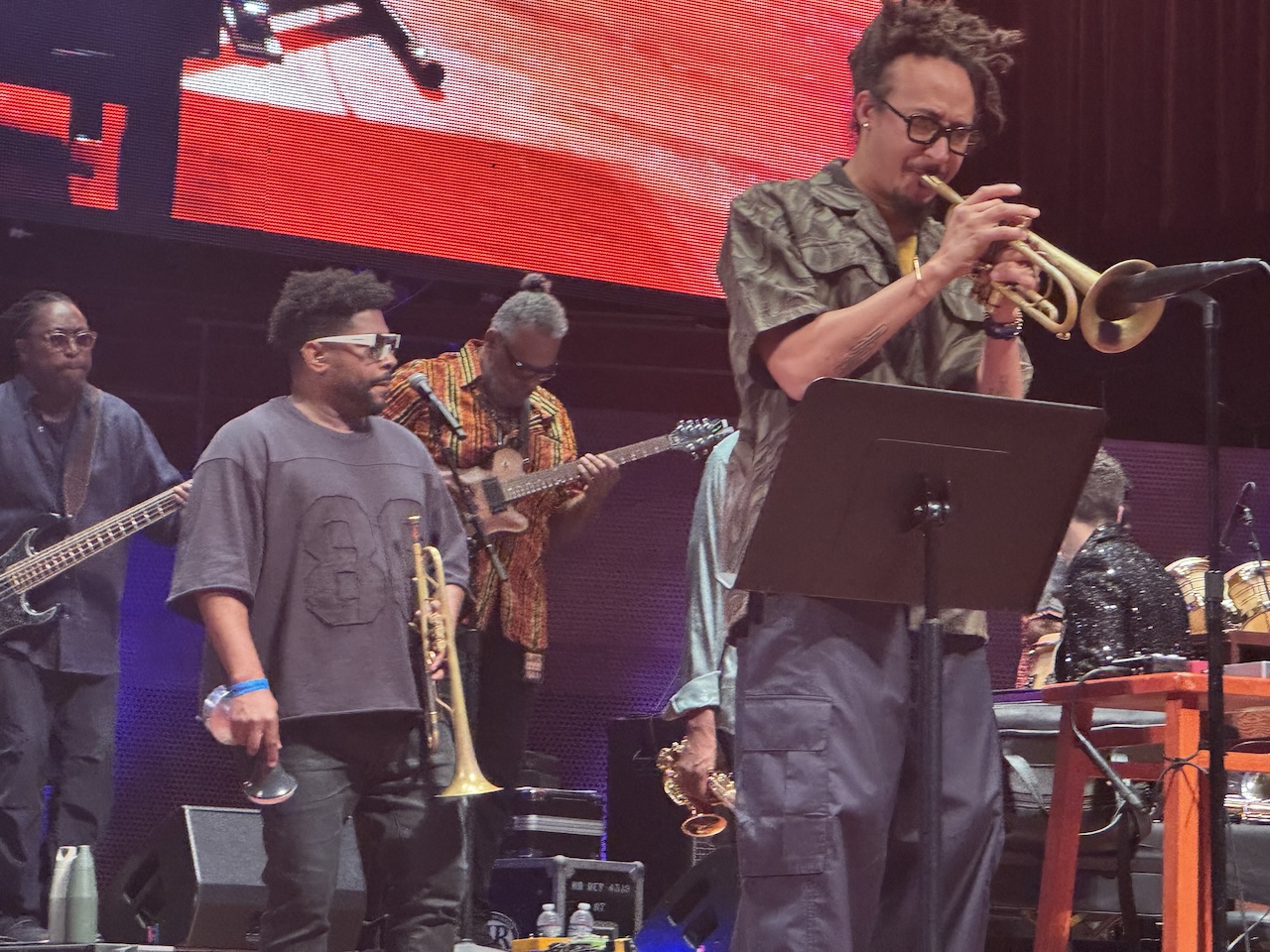
M.E.B Miles Electric Band hits the stage to celebrate Miles Davis, the ultimate embodiment of creative canvas. The long-awaited evening breeze mixes with the excitement for one of the most anticipated performances of this season, and the electricity in the air rises as soon as the all-star lineup joins forces for the opening tune. Here’s trumpeter Theo Croker, Antoine Roney on sax, guitarist Jean-Paul Bourelly, Robert “Baabe” Irving III and Greg Spero on keys, bassist Darryl Jones, percussionist Munyungo Jackson, DJ Logic and DJ Hapa on turntables, the band’s artistic director/drummer Vince Willburn Jr. (Miles’ nephew), and Rasaki Aladokun on talking drum.
The genius of Miles Davis’s music is that it can be so many things and none of them at the same time; it allows you to construct anything you want, and with the limitless number of building blocks to pull from. While there’s power and beauty in that freedom, it does come with a price. I’m sure this intentionally distorted mashup will likely get mixed reviews, but the older I get, the more I allow music (and everything else around me) to just be. Being able to witness aforementioned legends on stage and experience their vision is a privilege, especially in the world of technology revolutionizing entertainment. Despite all that, live music, especially live jazz, still remains unmistakably human because it’s never been about perfection. Authentic magnetism is something algorithms won’t ever replace, and the electrifying energy M.E.B produced on stage that night was a true testament to that.
Reviews aside, no better place to honor the eras and music of Miles and Trane, the architects of progressive jazz, than the city where the improvisational sound of hot jazz transformed into a structured, internationally appreciable art form, none of which would’ve happened if it wasn’t for Chicago’s South Side club and recording studios. It’s crazy to think that Jazz Showcase, the city’s oldest surviving jazz venue, a few blocks distant from the Festivals stage, will turn 80 next year. Experiencing alto saxophonist Bobby Watson’s quartet there, and all the amazing musicians coming through to jam during the festival weekend, served as a much needed mental switch from the formalities of the Pritzker Pavillion press pit, and a reminder that jazz has always lived in such informal community spaces.
Last spring I was invited to Kind of Blue REVISITED, a special night at Studio l’Ermitage (Paris) honoring Miles and featuring an international cast of accomplished musicians, including Los Angeles-based drummer Jonathan Pinson. It was nice catching up with Jonathan at Jazz Showcase right after saxophonist Isaiah Collier’s tribute to Trane, both in support of bassist Emma Dayhuff’s ensemble and in his own “Chicago Project.”
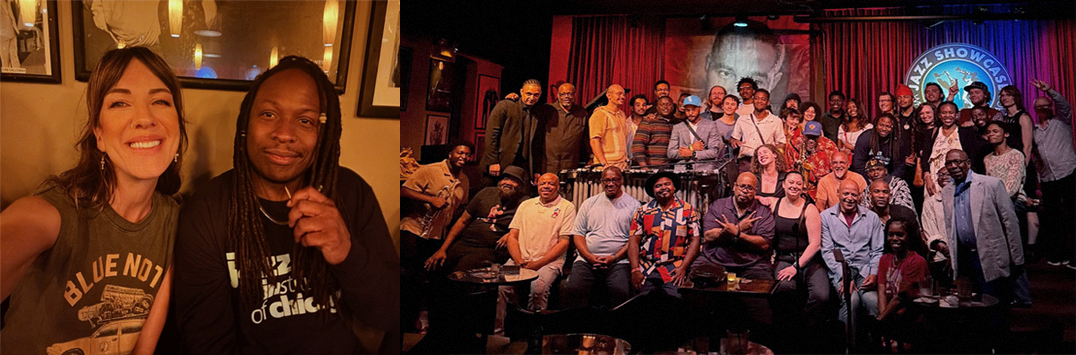
As I was chatting with Collier about his experience honoring one of the most significant figures in music, I kept thinking about Coltane’s words about music being the spiritual expression of one’s faith, knowledge and being. Sometimes we think that we need to bring to art all the information and knowledge in this world, but the only thing you can bring is who you are, the experiences you’ve had up to this moment.
While this year’s programming was overall impressive and quite diverse, there were two specific performances that, in my opinion, truly lived up to the sentiment of deeply personal storytelling. The first one was delivered by vibraphonist Joel Ross, a South Side native, and Good Vibes, the band he formed back in 2015 upon moving to NYC. Exploring biblical narratives, Good Vibes interprets scripture through jazz, with each composition carrying the emotional weight of the texts Ross includes in liner notes to the album version. The band members, saxophonist Devin Daniels, pianist Tyler Bullock II, bassist Kanoa Mendenhall and drummer Jeremy Dutton, do not all play with the same pulse, an approach inspired by Miles Davis’s Second Great Quintet (with Herbie Hancock, Wayne Shorter, Ron Carter and Tony Williams). In addition to the rhythmical language, what I found really interesting about this particular performance was the use of negative space, the intentional pockets of stillness, a gentle invitation to opportunity. As a band leader, Ross created a beautiful balance between remarkable sensibility and conceptual clarity, all the while making space for sound to flow and layers to unfold. It felt like a breath of fresh air and a reminder that any personal belief or experience can be alchemized through sonic interpretation.
Another notable performance within a context of personal storytelling was delivered by Patricia Brennan, the recipient of 2026 JJA Mallet Instrument Player of the Year Award. Breaking Stretch, the record her Septet played tunes from, was named top album in the 73rd Annual DownBeat Critics Poll.
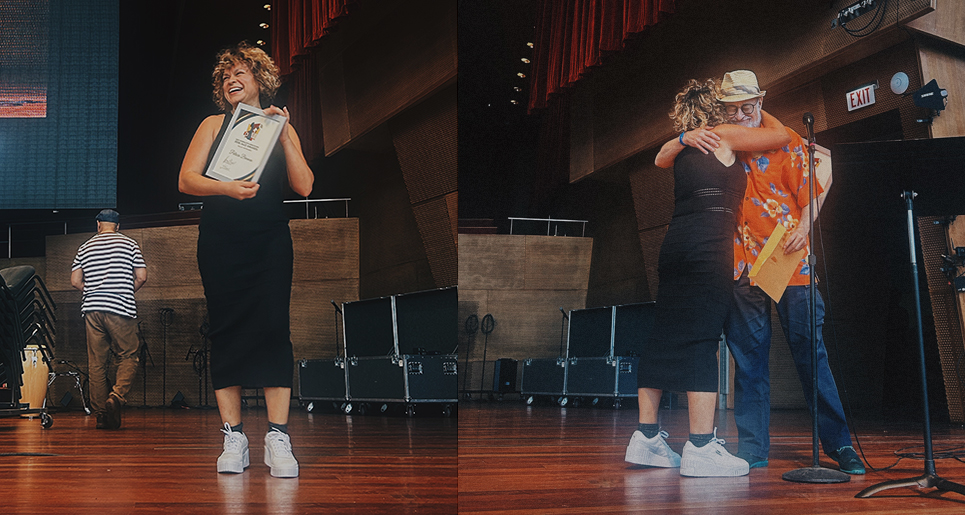
When introducing the audience to “555,” a strongly punctuated and beautifully moody track off the record, Brennan talked about the influence of math on her life and the similarities between music and math. I related strongly to this, having both math and arts degrees. Math as a field of study is extremely creative as it describes and examines rhythm, the most universal language lying at the core of all creation. In addition to that, Brennan reflected upon her journey as an immigrant since moving to Philadelphia from Mexico with one suitcase at the age of 20, and how the realization of spending the same number of years outside of her home country made her reflect on that journey even further. Hearing a personal story like this within a festival setting felt refreshing, and it proved time and time again that all immigrant stories are equally personal and universal, and that underneath our surface-level differences, we’re all navigating the exact same experience.
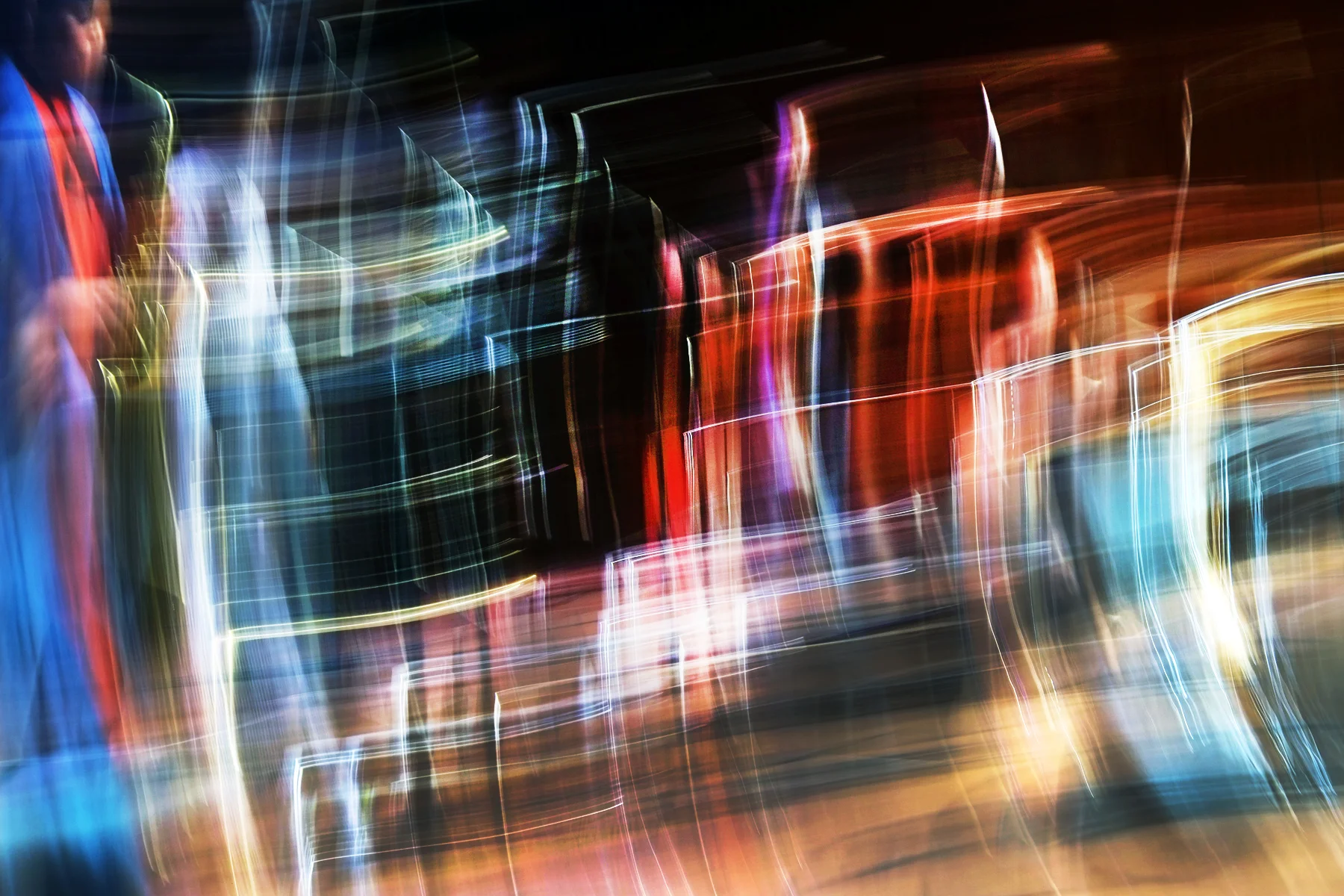
And just like the existential experiences can be alchemized through sonic interpretation, music can be turned into a sensory adventure through textures and visual landscapes. Created by photographer Lauren Deutsch and filmmaker Jonathan Woods, Tangible Sound: Arrival to a Higher Ground across Michigan Avenue from Millennium Park at the the Chicago Cultural Center is an immersive three-gallery exhibit translating the power of improvised creative music into color and movement. To capture the music itself and the spontaneous nature of free improvisation, Deutsch uses the streaks or so-called sound palettes.
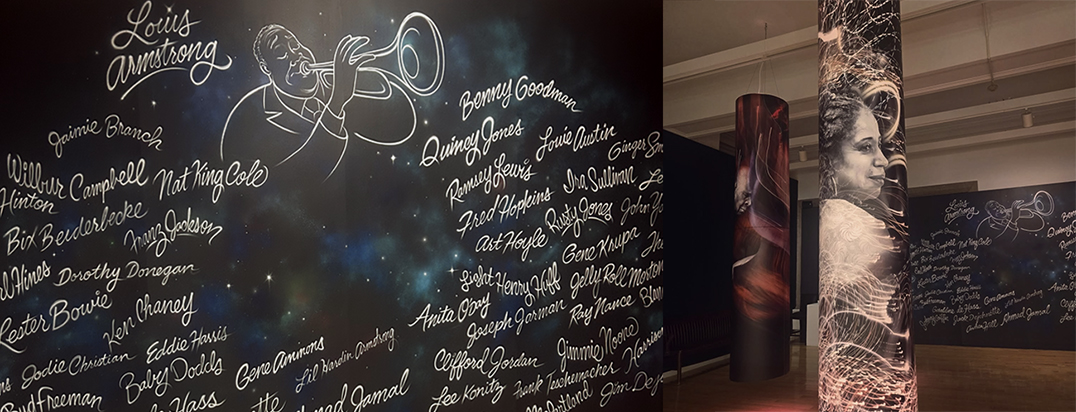
“Improvisation is not about making things up as you go along. It is about making informed choices in the context of multiple perspectives that bring multiple possibilities,” the photographer shares in her artist statement. Improvisation sounds just like life, which is what Gershwin pointed out when he famously compared the two.
As I was browsing the exhibit, I looked at the wall and saw “Musicanity,” the iconic poem by Khari B, opening with “Send me to a place where music is the only religion” and closing with “Listen. Love. Dance. Clap and enjoy.” That poem was first performed alongside the Great Black Music Ensemble at the Velvet Lounge almost 20 years ago, and as I was taking it in line by line, all I could feel was immense gratitude that, almost two decades later, there are still spaces where we continue building our very personal yet somehow profoundly universal relationship with music, where music is the only religion, where we can still listen, love, dance, clap and enjoy.
The Chicago Jazz Festival is produced by the Department of Cultural Affairs & Special Events (DCASE) and programmed in collaboration with the Jazz Institute of Chicago.