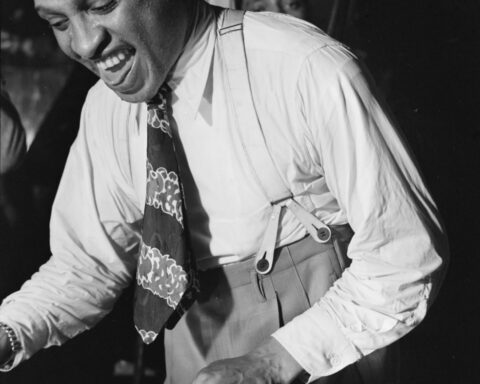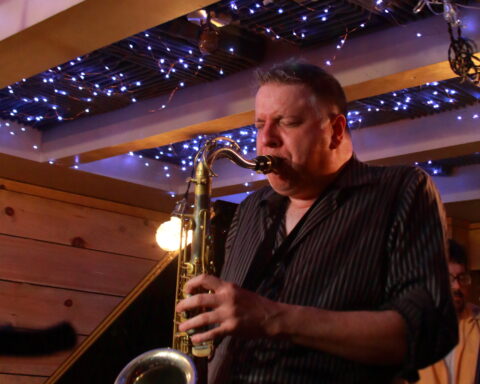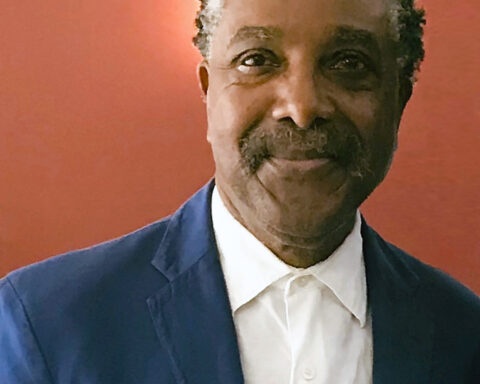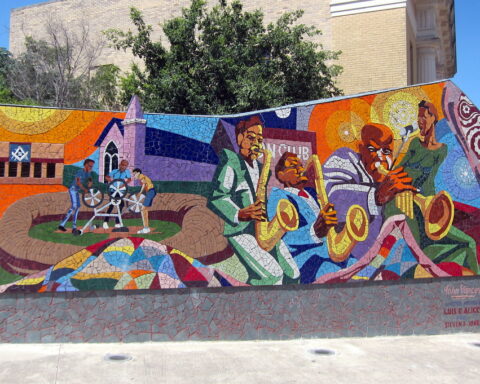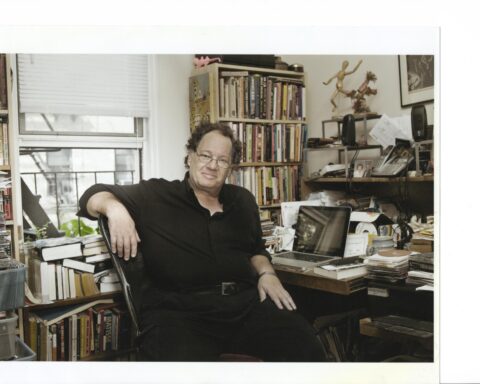
Photos by Jarko Vesic
One of Europe’s most impressive jazz festivals – Beogradski Jazz Festival – has created and maintained, for over half a century, a good reputation.
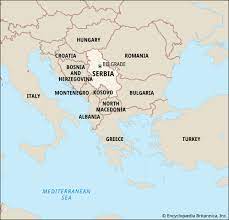
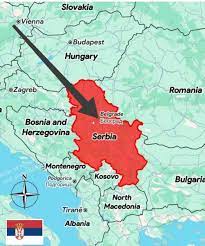
The first edition was held in the autumn of 1971 in the (then) capital of Yugoslavia, under the title Newport in Belgrade Jazz Festival, as a result of the optimal collaboration between the local organizers and jazz impresario George Wein, founder of the legendary festival in northeastern USA.
From the very beginning, the program featured overwhelming names: the opening concert was performed by the world’s archetypal big band – Duke Ellington and His Orchestra, followed by the illustrious Giants of Jazz: Dizzy Gillespie, Thelonious Monk, Sonny Stitt, Kai Winding, Al McKibbon and Art Blakey. As if that were not enough, the audience was treated to the impressionistic ramblings of vibraphonist Gary Burton, the avant-garde radicalism of Ornette Coleman’s Quartet, and the explorations of electric coloratura endorsed by Miles Davis & co.
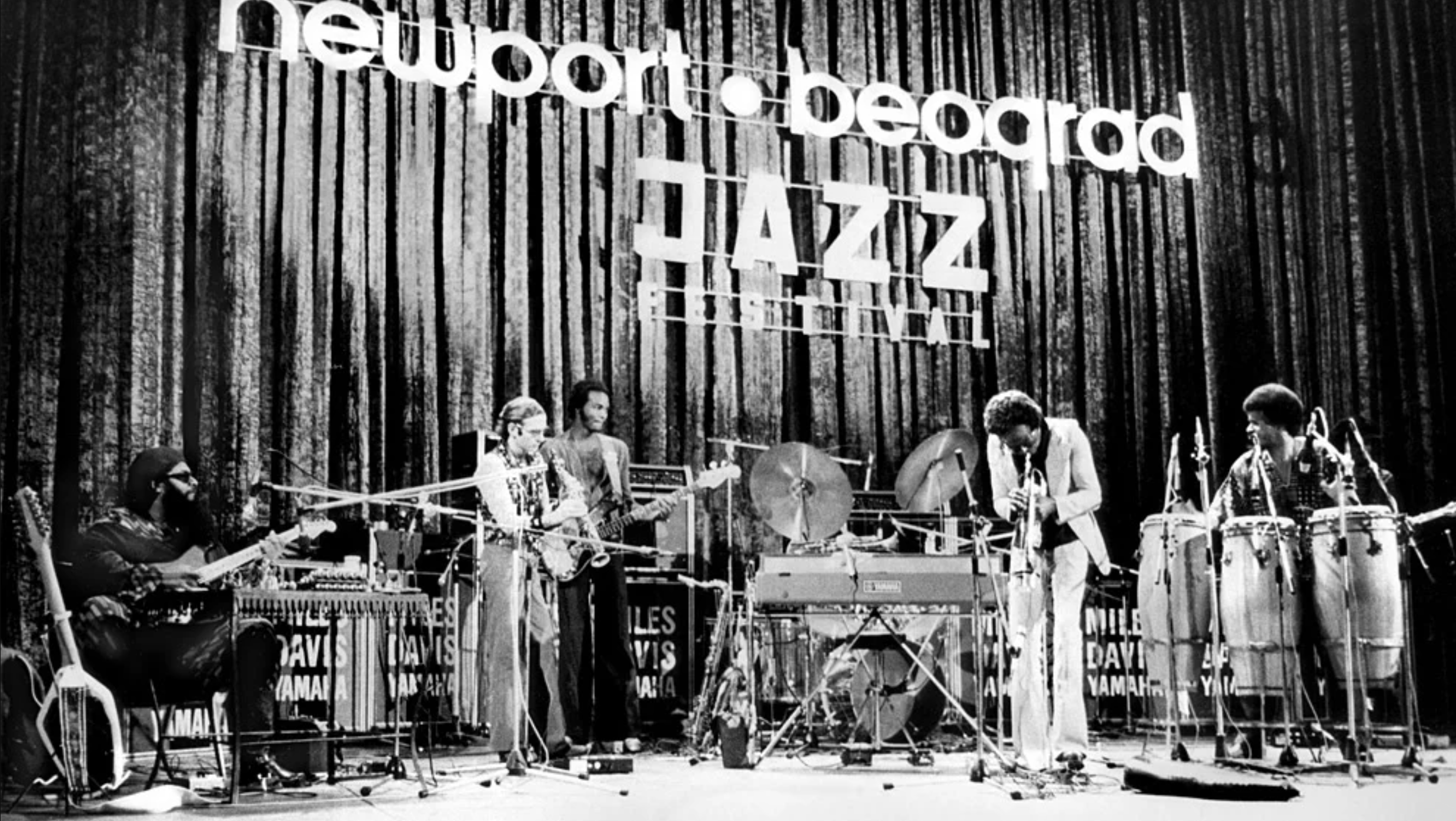
Since the State Department had refused to support the latter’s trip to Europe due to the famous musician’s controversial political views, his recital in Belgrade was arranged through the intervention of the great Yugoslav trumpeter Dusko Goykovich, who convinced his American friend to play beyond the Iron Curtain. By 1990, the share of musicians from the USA represented about half of the number of those invited. The names inscribed in the archive of the Belgrade Festival can form a representative selection for the genre’s history in the last 50 years. The trauma of the civil war in the final decade of the last century caused a 15-year interruption of this exemplary model of international cultural cooperation.
Fortunately, the strong core of Serbian jazz promoters, led by the indefatigable jazzologist Vojislav Pantic, managed to restore the festival to its rightful place on the world stage. The main organising institution remains the Belgrade Youth House (Dom omladine Beograda), with its multifunctional spaces appropriate to the jazz requirements – a fact confirmed by the glorious names that have graced its two stages over the 41 editions held so far. As such, the festival also benefits from the support of the Belgrade City Hall and the Ministry of Culture of the Republic of Serbia. Pantic’s and his company’s diplomatic skills were materialized this year in fruitful collaborations with the Italian Institute of Culture, Spain’s Cervantes Institute, the Israeli embassy, the French Institute, Portugal’s Camões Institute, etc. Towards the end of my review I shall return to the ways in which Pantic and the team continue to present valuable American musicians to the Serbian public.
My old dream of attending the famed Belgrade event someday came true in the autumn of 2025, thanks to the good recommendations received from Dragoslav Nedic. He lives in Romania’s westernmost city of Timișoara, and has received JJA’s Photography of the Year award for the portrait of Jazzmeia Horn, taken during the 32nd edition of the Belgrade Festival. Since, for family reasons, Dragoslav could not participate in the current edition, my journey on the Timișoara-Belgrade route was ensured by his friend and disciple, photographer Jarko Vesic, a trusted companion whose photographs accompany these comments. As one can tell from their names, these two compatriots of mine are part of the Serbian community living in Romania.
The first of the four festival galas was marked by a grandiose concert performed by the RTS Big Band.
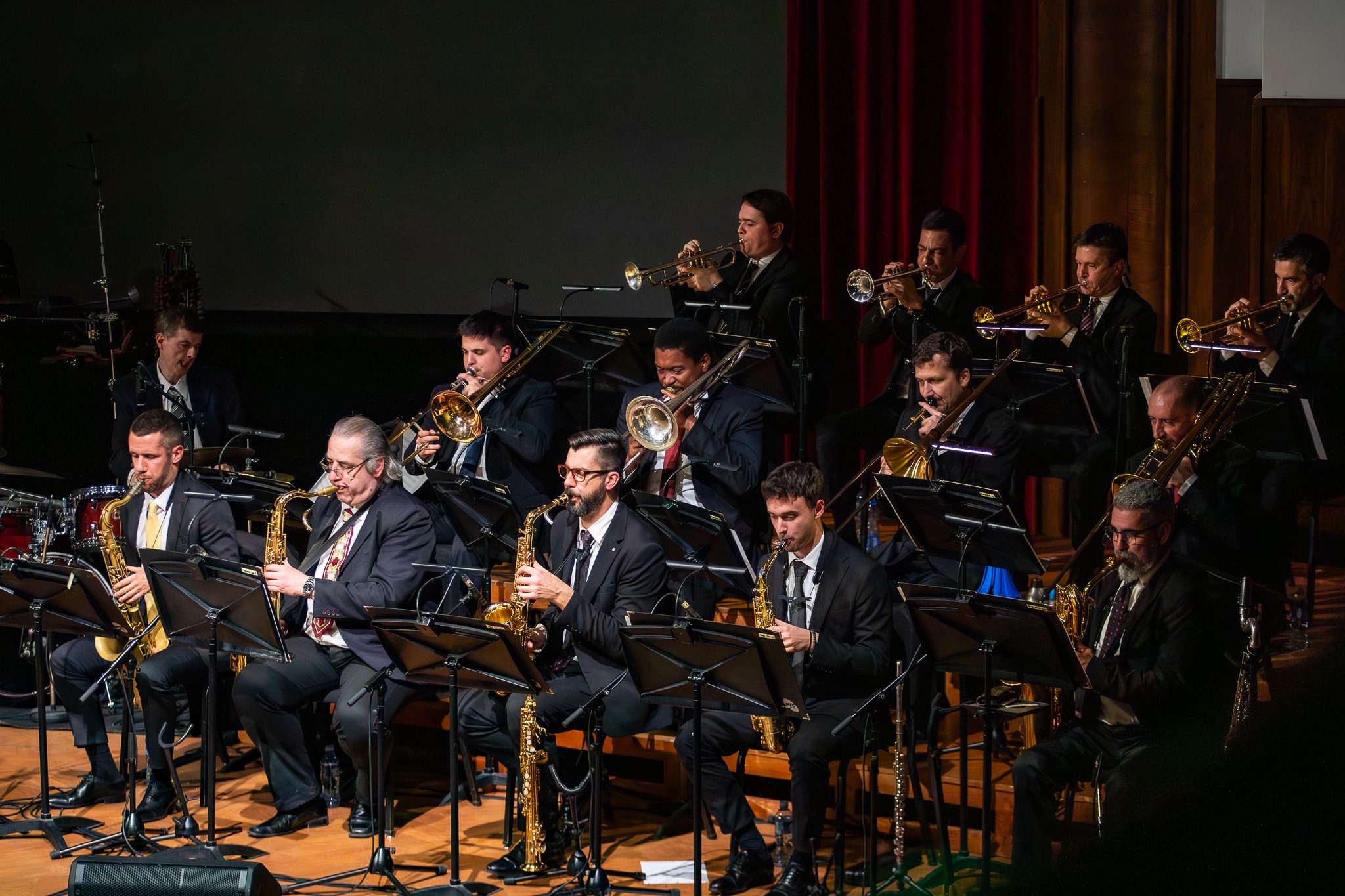
An ensemble with a well-established professional status, sponsored by the State Radio and Television of Serbia and founded in 1948 (so even older than the undersigned, born in 1951). I had first encountered its present conductor, Stjepko Gut, during the unforgettable evolution of the Markovic-Gut Sextet at the Sibiu Festival in 1982. Born in 1950 in Ruma, in northern Serbia, Gut is a world-class trumpeter, also established as an ensemble leader, composer, arranger, and university professor.
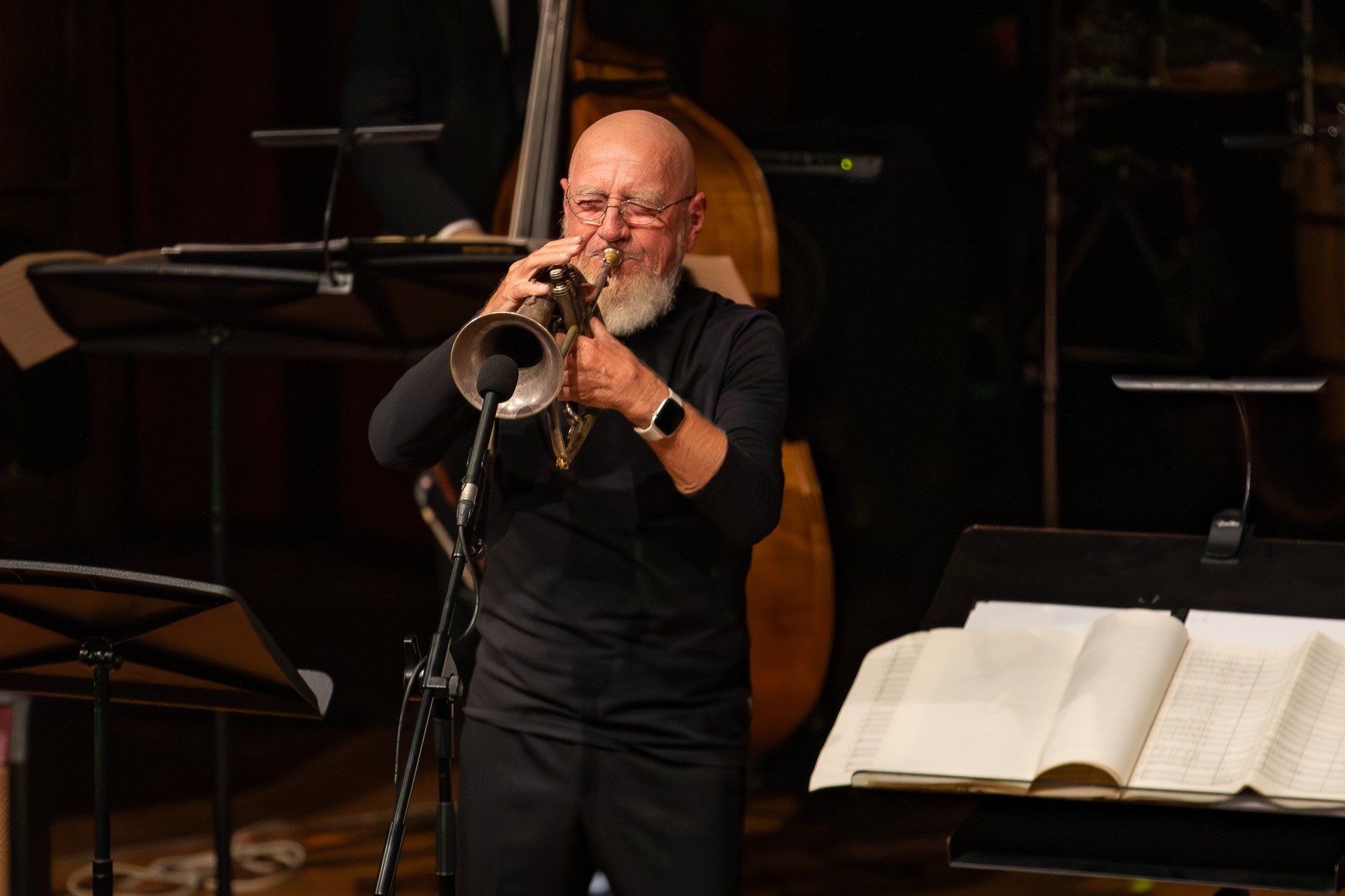
The show he staged in Belgrade excelled in the primordial qualities of classic big bands – dynamism, energy, swing, homogeneity, spectacularity, etc. – as well as in local accents. These came largely from the compositional legacy of Bora Rokovic (1925-2006), a prominent figure in Yugoslav jazz, with a role somewhat similar to that played in Romania by Richard Oschanitzky. The tribute to Rokovic’s centenary included compositions of his own performed with the Yugoslav All Stars Band, which he had led together with Dusko Goykovich at the Newport Festival in Belgrade in 1972. Gut’s orchestral arrangements, his conducting mastery and trumpet interventions generated music to the taste of a largely informed audience, receptive to the point of enthusiasm. The ensemble’s sonorities displayed masterfully polished polyphonies, while the lyrical passages evoked impressionistic paintings, relying on the transparency of the chords emitted by the rich sections of wind instruments. Under such conditions, everything culminated in a contemporary reprise of the song “Essential Blues” by the aforementioned ensemble from 1972. Therefore, the RTS Big Band led by Stjepko Gut implicitly imposed, from the very beginning, the value criteria on which the entire festival would function.
In chronological order, two recitals followed, supported by big names in French jazz: double bassist Henri Texier and reedsman Louis Sclavis. Both confirmed their high rank in the jazz hierarchy, defying the age recorded on their birth certificates – Texier, born in 1945, Sclavis, born in 1953. The revelation, for me, was the performance of Henri’s son, Sébastien Texier, especially on the bass clarinet (which is, incidentally, one of the instruments well-valued by the jazz made in “l’Hexagone”). An opportunity to remind myself of the memorable concerts held in Romania, at the end of the last century, by the exponential group Henri Texier/Aldo Romano/Louis Sclavis, in which the latter shone as a bass clarinetist. His performance in Belgrade, along the lines of his own neo-romanticism in agreement with pianist Benjamin Moussay, materialised in improvisational formalisations as if meant to thwart the pre-established plans of the invading AI.
The recital of the Eternal Love Quartet, led by the unstoppable master of the saxophone-soprano
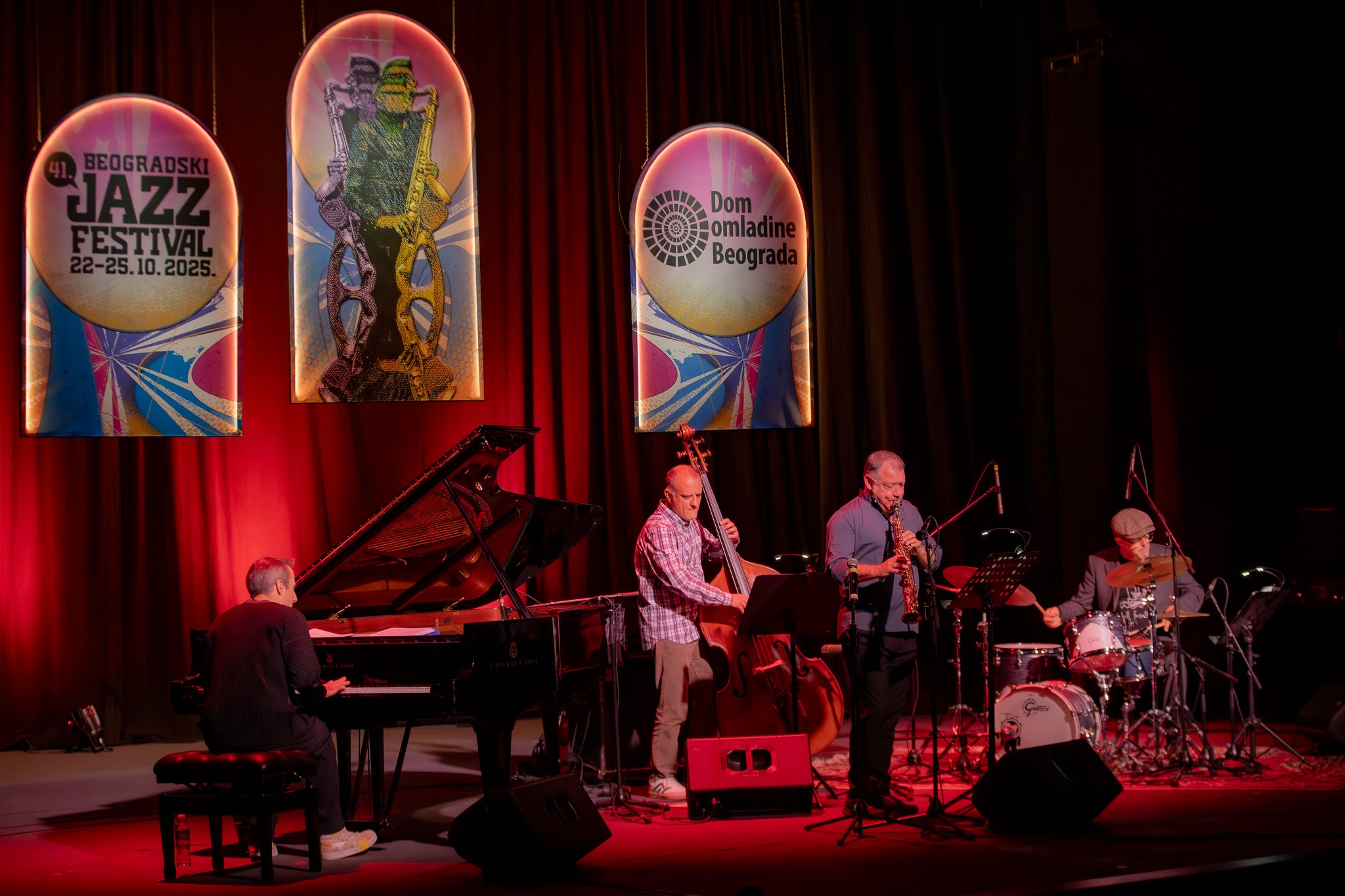
Roberto Ottaviano, was characterised by nerve, rhythm, implicit swing, neomodernist grooving à l’américaine… – elements neglected by both programmes mentioned in the previous paragraph, with their quasi-exclusively chamber atmosphere. The band’s very name refers to what Ottaviano considers to be collective improvisation: a kind of contemporary “Missa solemnis,” celebrated by the musicians and enjoyed by the audience. The rhythmic background was in the custody of double bassist Giovanni Maier and drummer Zeno De Rossi, and the “harmonic sector” was the responsibility of the English pianist Alexander Hawkins, with his angular-unpredictable solos. The sopranoist born in Bari in 1957 manages to drag his three fellow musicians along with him in wild fugues, keeping the listeners’ interest constantly alive. The saxophone notes follow each other with speed, in cascades of legatos bearing the mark of John Coltrane. There are also explicit references, as in the case of the tribute piece dedicated to pianist Mal Waldron, or in the Monk-inspired theme “Homo sum” (= Latin for I am a human) – another expression of Ottaviano’s combativeness in favor of humanist ideals. Among the observations made by the musician between the pieces, I would cite the sentence “The world is in conflict with itself,” juxtaposed with the theme “O Caminho das Aguas” (= The Path of Waters) by Brazilian singer-songwriter Rodrigo Maranhão. Like the entire recital, some kind of natural-musical healing for our current mundane sufferings.
After his evolution in the company of his Italian colleagues, pianist/organist Alexander Hawkins (b. 1981 in
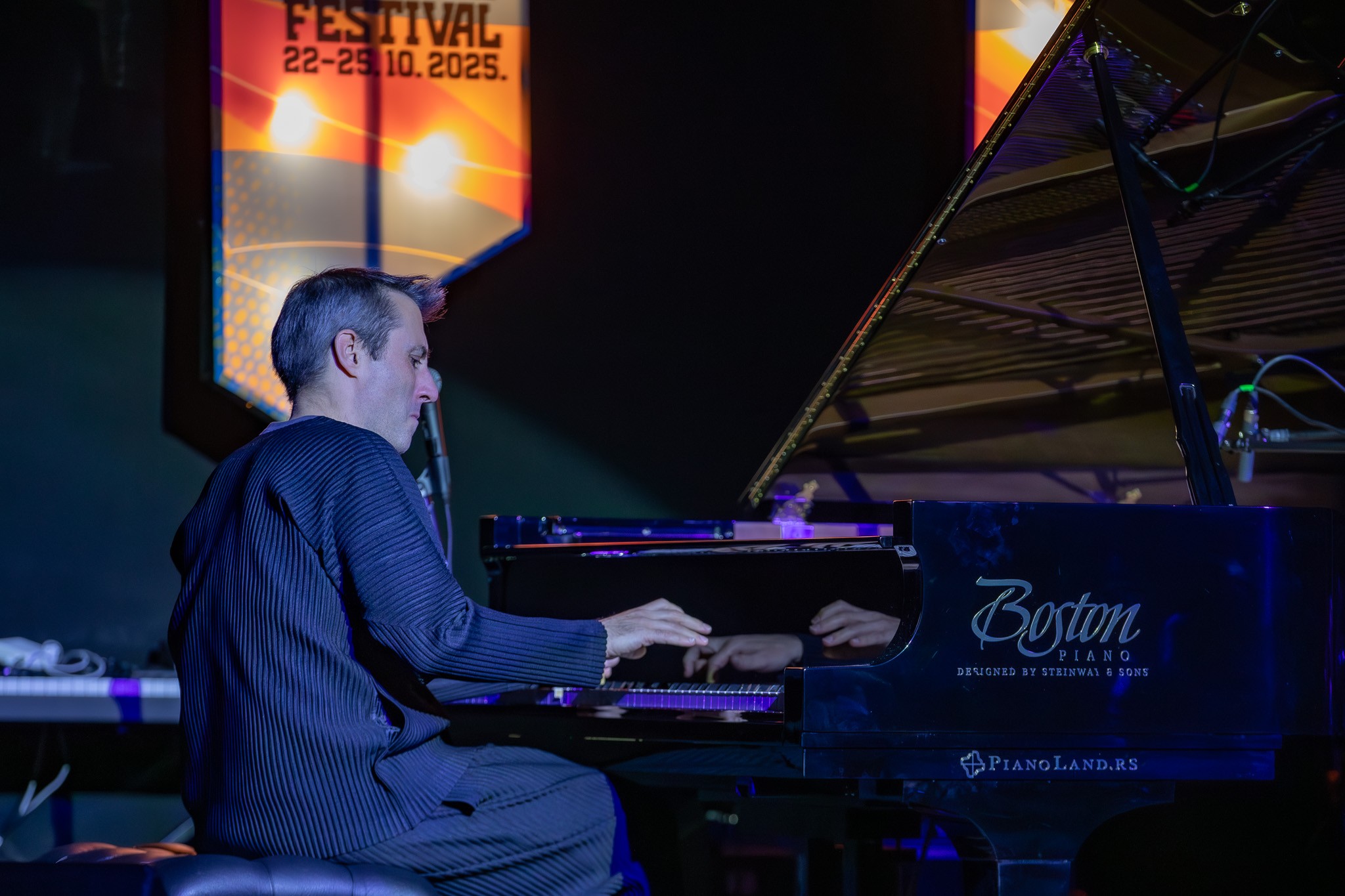
Oxford) offered us an individual demonstration of his capabilities as an improvising instrumentalist. In the Amerikana hall of Dom Omladine (dedicated to night concerts and jam sessions), he gave a solo piano recital, with all-encompassing references – from Art Tatum or Bud Powell, via Thelonious Monk, to Cecil Taylor or Dollar Brand – but permanently filtered through an acute awareness of his own vision of the art of sounds. Personally, I was delighted to discover, for example, “Take the A Train” (the soundtrack of the world-wide audience broadcasts made by Willis Conover on the Voice of America radio during the Cold War), recomposed from disparate sound fragments and finished in a furious tempo. Inevitably, I remembered the similar approach once made by Dollar Brand/alias Abdullah Ibrahim. Hawkins’ immense capacity for relating in the globalised world of jazz (see also his collaboration with Ethiopian vibraphonist Mulatu Astatke) does not diminish his personal creativity, but rather stimulates it. After such a feast of supple gumption, the music of the Bosque Sound Community septet, led by bassist Milos Bosnic, although carefully conceived and beautifully performed left a rather conventional impression.
The trio of pianist Marta Sánchez (b. 1983 in Madrid, relocated to New York in 2011) focuses primarily on the leader’s compositions. They are contorted themes, with unpredictable melodic developments and frequent conglomerations of apparently erratic notes, but intimately linked to the score. Moreover, the abrupt endings of the pieces attest to the importance given to pre-established structures. It could be that such … conceptual precautions are a response to the pressure of the competitive environment in the jazz metropolis of N.Y. In any case, as Marta Sánchez seemed to move away from “notated improvisations“, her authentic jazz talent came out more clearly. The climax was reached in a savory encore, expressed without restrictions concerning spontaneity, according to Thelonious Monk’s immortal legacy.
A duo of trumpeter Wadada Leo Smith and pianist Sylvie Courvoisier is pure avant-garde essence.
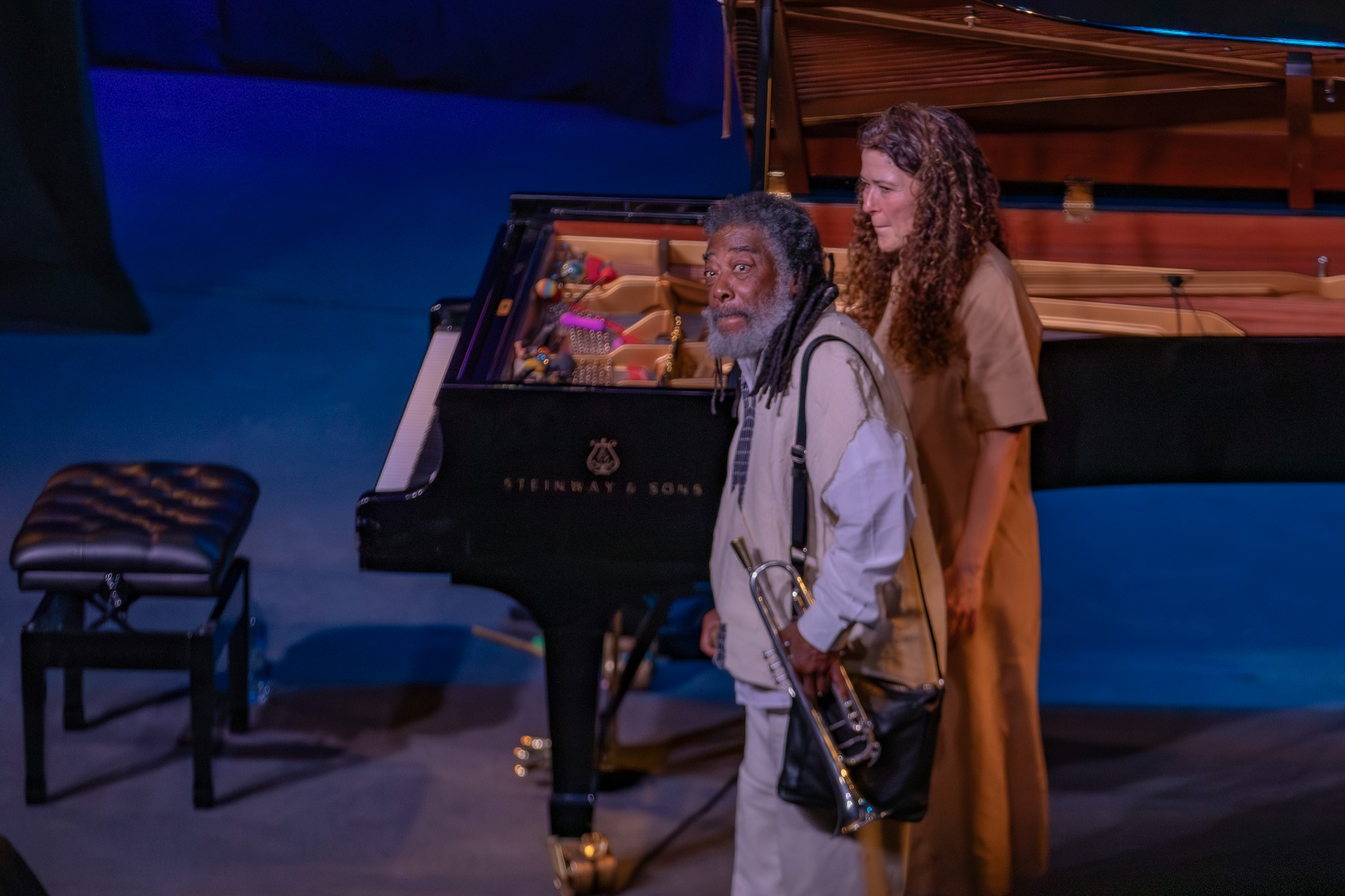
Their collaboration began in 2017, at a concert curated by John Zorn. As critic Thierry De Clemensat, a member of JJA, rightly observed, what is remarkable in their case is not the display of instrumental technique, but the restrained expression: “There are no elaborate arrangements or self-conscious gestures of virtuosity. Instead, there is the quiet audacity of two master musicians listening deeply, negotiating space, and finding a shared equilibrium. The pieces breathe, expand, contract, and then drift into unexpected resolutions.” (Paris Move, Oct. 2025).
Born in Leland Mississippi in 1941, Wadada has a Methuselah-like allure, wisely launching the last evocative signals of a terrestrial civilisation still undisturbed by messengers from other worlds. His trumpet releases strange, indefinite melodic fragments, as if invoking the Afro-American roots of jazz from the perspective of post-serial aesthetics. An attitude justified by his direct participation, starting in 1967, in the efforts of Chicago’s famous AACM, alongside such luminaries as Muhal Richard Abrams, Roscoe Mitchell, Joseph Jarman, Lester Bowie, Henry Threadgill, Anthony Braxton …
In turn, Sylvie Courvoisier (born in Lausanne, Switzerland, in 1968) integrated herself into the innovative American scene, after settling in New York in 1998. According to her own confession, she suggested to Wadada that, in their joint appearances, they completely avoid written scores, allowing the music to unfold without predeterminations. In essence, we are dealing with an assumed aleatory ethos, within which the pianist treats the noble concert instrument in a holistic manner – exterior / interior – not only as a repository of classicized memory, but also as a fertile source of percussive effects and unconventional procedures. The coherence of the project is maintained with para-melodic means, trumpet sounds covering the spectrum from acute to sigh, from the brilliance of a biblical silver trumpet to the timid breathing emitted through the mute, imprecise whines through the mouthpiece sometimes led to fleeting climaxes, complemented by ample glissandos across the entire keyboard, atonal piano playing, vibraphone sticks sliding on the piano wood, its strings prepared with strips of film, lightning-fast bursts hammering the keyboard, etc.
In other words, an eventful, purely acoustic music, also including imprecisions, hesitations, aspirations, failures, typical of human nature. An understanding of sound art as an assumption of our transient condition on Earth. The audience’s reverent-comprehensive attitude impressed both musicians. Aware that this was his last European tour, upon leaving the stage, the venerable maestro Wadada Leo Smith addressed the audience with the phrase “We knit together our hearts through music”…
In line with director Pantic’s concern for promoting jazz in Serbia, we had the opportunity to get acquainted with saxophonist Rastko Obradovic’s Quartet. Born in 1995, the discreet-efficient musician has already accumulated serious professional credits – specialised studies at the Oslo Conservatory, leader of the saxophone section of the RTS Big Band, an album in duet with the acclaimed pianist Bojan Z. Attractive without ostentation, the compositional proposals of this group benefited from the refined contribution of pianist Vladan Veljkovic and, as special guest, Danish bassist Jesper Hoiby.
A pleasant surprise was provided by the Israeli group Shalosh (= name of the number 3 in Hebrew).
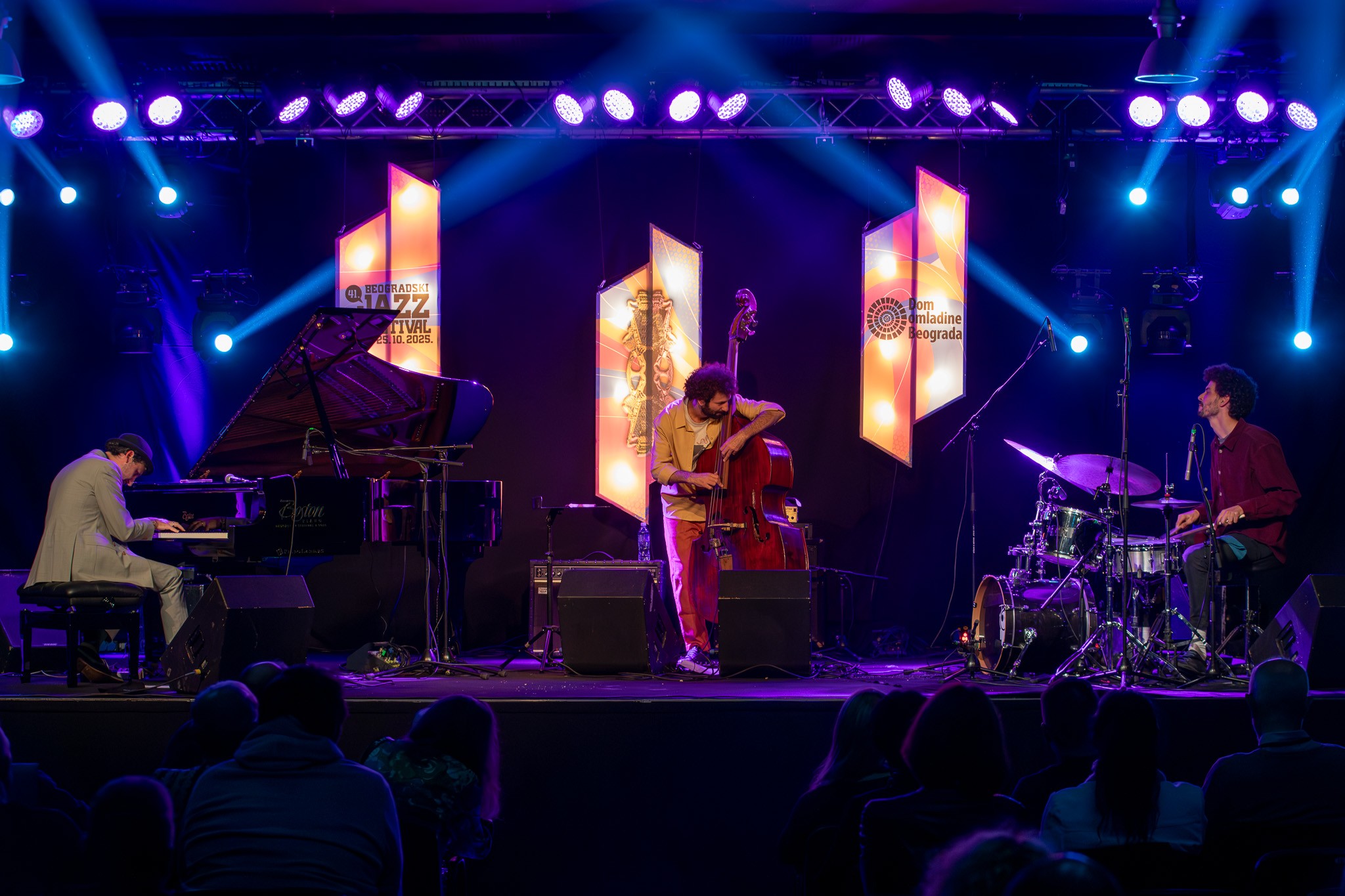
A well-chosen title, considering the excellent balance of the triad made up of pianist Gadi Stern, drummer Matan Assayag and double bassist David Michaeli. Their repertoire is supported not only by the deliberate interaction of the protagonists, but also by melodic clarity, ideational mobility, stylistic openness, genuine inclination towards persiflage and humor. The transitions from coherent thematic statements to disintegrations of formal structures follow one another in lightning speed, stimulating the intellectual complicity of the listeners. A piece dedicated to jazz genius Ahmad Jamal revealed one of Gadi Stern’s main sources. But the delightful ricochets of melodic paths, as well as the classical-avant-garde complexities also refer to another contemporary genius – Vyacheslav Ganelin, born near Moscow, established in Vilnius/Lithuania with his Trio (alongside Vladimir Chekasin and Vladimir Tarasov), and becoming after 1987 a guiding light at the Academy of Music in Jerusalem, home-city of the Shalosh Trio. It is no wonder that the Israeli group is currently collaborating with the renowned record label ACT, and was invited to perform at the 2025 edition of the largest jazz fair in the world, Jazzahead! of Bremen.
The Ricardo Toscano Trio is part of the young echelon of Portuguese jazz musicians, promoted in terms of discography by the Clean Feed label founded by Pedro Costa. On the stage of the Belgrade Festival’s main hall, saxophonist Toscano, double bassist Romeu Tristão and drummer João Pereira performed a programme of well-tempered intensity, which did not lack the deeply melancholic accents specific to the Lusitanian fado genre. However, I believe that the extent of their talent was more convincingly highlighted in the atmosphere of the post festum jam session organised in the Amerikana Hall, where they played more freely, in the stimulating company of colleagues originating from diverse cultural spaces.
The final concert of the 2025 edition of the Belgrade Festival was performed by the James Brandon Lewis Quartet. The band leader (born 1981 in Buffalo, NY) has already accumulated multiple official
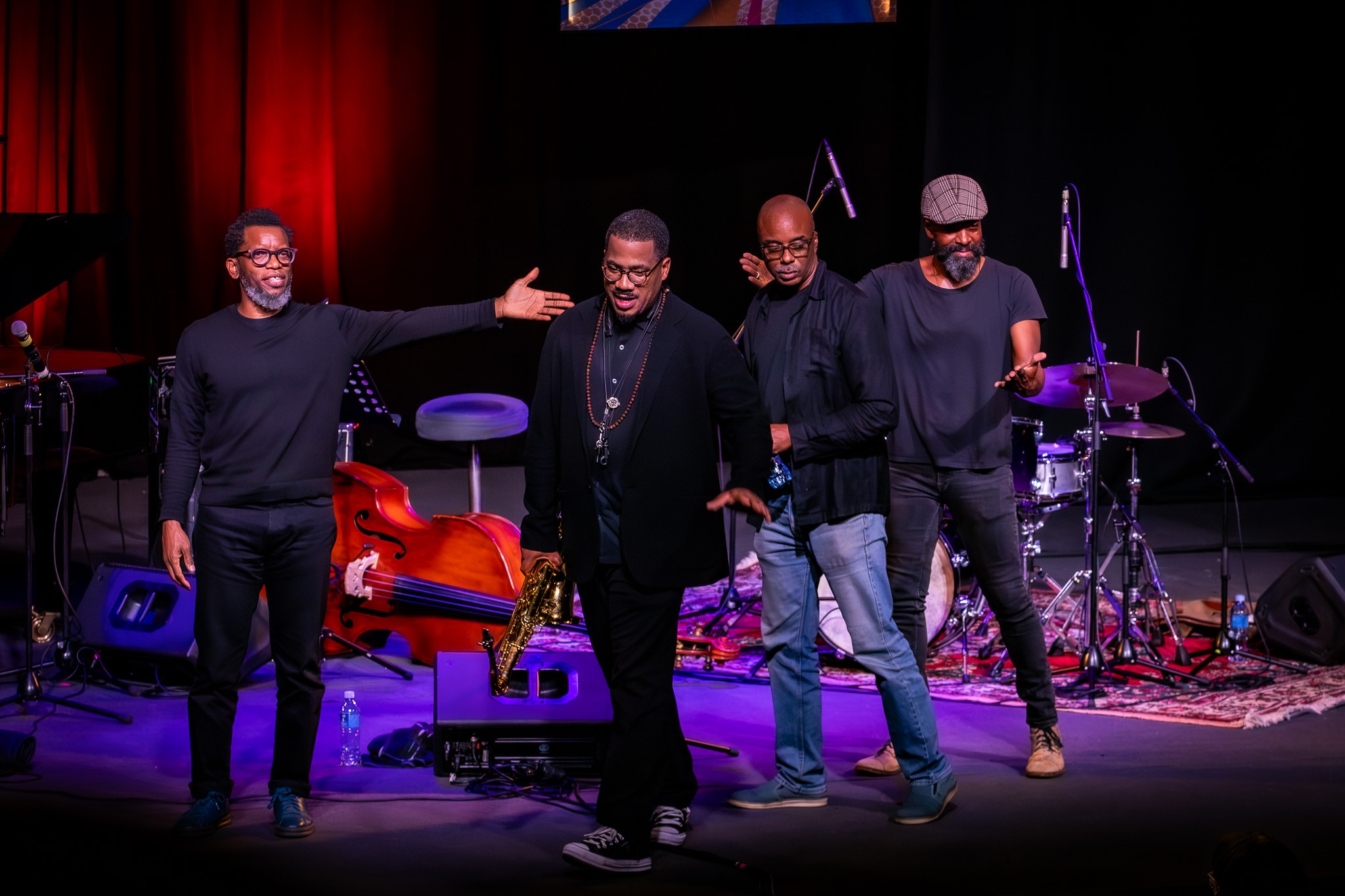
recognitions. The most recent are the titles of Artist of the Year (in 2024 and 2025) and Saxophonist of the Year 2025, awarded by the prestigious DB Jazz Critics Poll. Together with Aruán Ortiz/piano, Brad Jones/double bass and Chad Taylor/drums, Lewis presented compositions that erase the boundaries between genres, a procedure conceptualised by himself with the phrase “molecular systematic music”. His interpretative manner agglutinates an entire evolution of the tenor saxophone – with more explicit echoes of Benny Golson, Coltrane, Rollins, or … more tangential ones, such as Gato Barbieri, James Carter, Dewey & Joshua Redman, Steve Coleman, and others.
James Brandon Lewis’s basic strength, however, lies in his ability to ensure a personal form of creative, non-concessive eclecticism, of a certain complexity, without alienating his audience, but rather fascinating them. In this endeavor, the contribution of the Cuban pianist Aruán Ortiz seems decisive to me. Well integrated into the quartet, but cultivating his aesthetic conception, he provides his musical companions with a harmonic-melodic counterbalance derived from Caribbean baroque essences (researched, among others, by the writer and musicologist Alejo Carpentier). Fortunately, the well-known musicians based in New York agreed to cordially participate in the final jam session, coordinated by Serbian pianist Vlada Maricic.
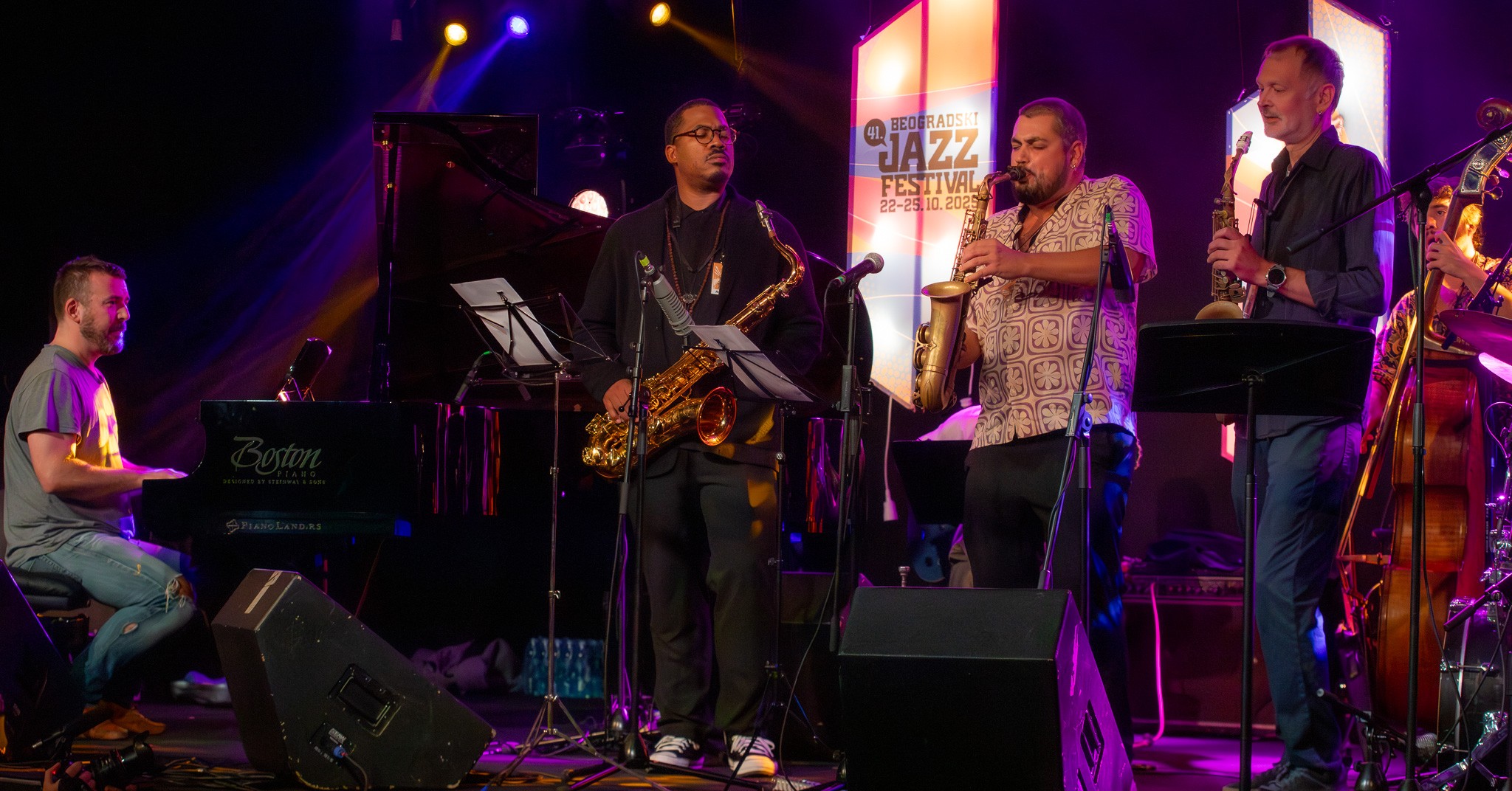
From my spontaneous conversations with James Brandon Lewis and Aruán Ortiz, I realized, once again, the immense advantage provided to me by the fact that I am a member of the editorial board of DownBeat magazine and its Critics Poll as well as of the JJA. This is instantly effective in establishing spontaneous contacts within the high society of jazz. My profound gratitude to Howard Mandel, Frank Alkyer, the late W. Royal Stokes, John Edward Hasse, Art Lange, Jason Koransky and the other American confreres!
Like me, many have probably wondered how it is possible that, year after year, the Belgrade Jazz Festival can boast top musicians from the world stage. In addition, the tradition of many of them coming here from the very homeland of jazz – the United States – is maintained. From what I have deduced, a crucial role in this regard falls to the impresario Jakob Flarer, originally from the Alto Adige region of Italy. He heads the Saudades tour organizing company, located in Innsbruck/Austria, with recognized skills in promoting innovative jazz trends and, above all, facilitating transatlantic contacts.
As unlikely as it may seem, the week immediately following the Belgrade event, a similar festival took place in Pancevo – located 20km from the Serbian capital – under the guidance of the same Voijslav
Pantic. The autumn 2025 edition brought together world-renowned artists, such as: Dave Holland, Danilo Perez, John Patitucci, Adam Cruz, Dave Holland, Nasheet Waits, Yuval Cohen Orchestra, Serbian All Stars Ensemble, Tord Gustavsen. I have no doubt about Jakob Flarer’s contribution to the success of this event. Just as it had been in Belgrade, also in Pancevo the festival tickets were sold out. Another demonstration of the insatiable interest in jazz of the Serbian public and organizers.