Now in its 12th edition, the Bran Jazz Festival is consolidating its prestige
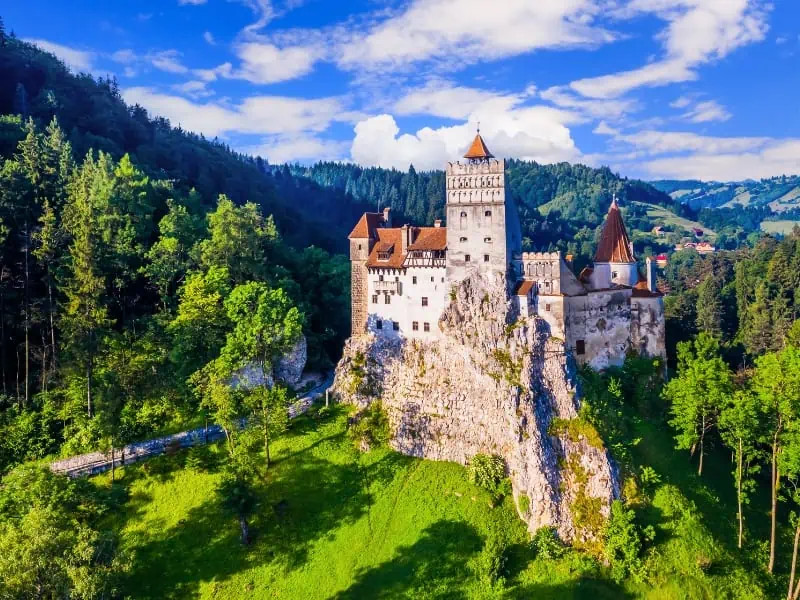
year after year. Although the seats available for spectators in the picturesque enclosure of the homonymous Castle (founded in the 14th century) are limited to about 100, the quality of the program and the ambience deserve superlative praise.
All the more so, since during the last year the renowned museum-edifice has undergone an administrative metamorphosis. Fortunately, marketing director Alexandru Prișcu and Bucharest jazzologist Paul Tutungiu managed to overcome the inherent obstacles, coordinating an admirable organizational team, so that I can comment on a truly memorable event.
A cultivated yet pragmatic spirit who is open to innovative ideas, Tutungiu summoned on the small stage in the inner courtyard of the Castle a succession of recitals subsumable to a double theme: Bringing to the fore the human voice (predominantly female), as well as the heteroclite origins of the invited musicians. Which might suggest as an alternative name “a Festival of Uprooting.” From this eminently cosmopolitan character another original aspect derived: most of the pieces were sung in idioms other than the world’s current lingua franca, English.
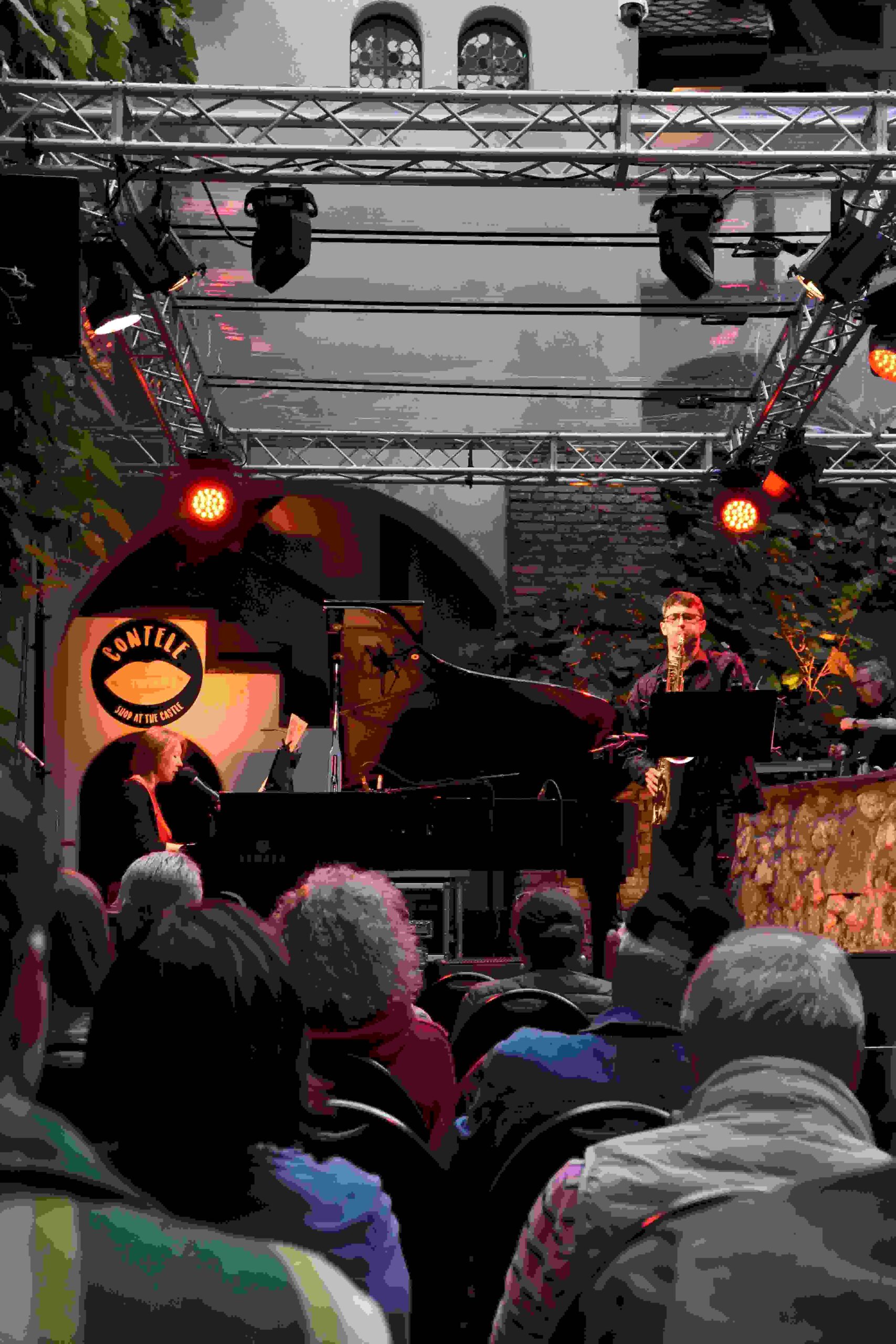
Thus the vocalist/pianist/composer Tamara Lukasheva, originally from Odessa but established in Germany, began her recital with a polyform suite, in which compositional rigor alternated with free passages, interconnected with the interventions of saxophonist Victor Fox. A stunning artist, Lukasheva displays her comprehensive vocal palette in a personalized version of contemporary music, which absorbs techniques from the post-free-jazz sphere.
The action takes place in balanced reciprocity with her young accomplice, Fox. The saxophonist seems to continue, on his own coordinates, the legacy of the Kölner Saxophon Mafia, an influential ensemble on the German jazz stage of the 1980s-’90s. It is worth emphasising the accuracy of the poetic diction of the lyrics sung by the pianist in Ukrainian, as well as in German – on texts by the great Austrian poet R.M. Rilke. To sum up her performance, I’d resort to three main characteristics: finesse, femininity, flair.
The same three alliterative words are also suitable for vocalist Elina Duni. She is the first Albanian singer to achieve notoriety in the jazz world (after settling in Switzerland). Her duet with British guitarist Rob Luft generates an atmosphere of warm lyricism, in which the ductility of the female voice is highlighted by the sounds modeled by Luft on the Gibson guitar and augmented by the use of electronic pedals.
It is not about pure accompaniment, but a fusion of thoughts and feelings in continuous reconfigurations. In addition to her musical abilities, Duni manifests herself as a polyglot, highlighting the onomatopoeic virtues of her native Albanian, as well as inflections of Italian, Greek and French origin. In an emotional coda she also sang passages from Romania’s legendary singer Maria Tanase’s famous song “Lume, lume,” in Romanian.
Another proposal, meant to surprise and delight us, brought together John Greaves (b. 1950 in Wales, vocalist, pianist, double bassist, investigator of the connections between jazz and poetry – e.g. Verlaine, Dylan Thomas, Ginsberg, Leonard Cohen . . . ) and the unpredictable vocalist and multi-instrumentalist Annie Barbazza (b. 1993 in Milan, launched at 19 as a drummer in the Piacenza concert of Greg Lake, ex-member of Emerson, Lake & Palmer and King Crimson). At Bran, the idiosyncratic couple was accompanied by producer Max (Massimo) Marchini, leader of the Dark Companion record label, founded in 2015 also in Piacenza. On stage, Greaves and Barbazza perform sophisticated lieder, as if meant to soothe the much-aggravated human sensitivity of the 21st century. Those are lyrical contents whose musical roots lie in the effervescence of progressive rock consecutively from the 1960s. Their literal meanings dissolve in contorted melodic fulgurations, where the echoes of the late Lake can suggest fragmentary associations even with such eccentrics as Zappa or David Bowie. All this, however, in a kind of intimate catharsis, accompanied on the piano by Greaves with parsimonious chords (which reminded me of Mal Waldron’s improvisations together with vocalist Jeanne Lee, in their concert in Cluj at the turn of the century).
Another “uprooting” duo brought together vocalist Simin Tander (born 1980, of Afghan-German origin, currently based in Oslo) and bass guitarist Björn Meyer (born 1965 in Stockholm, now living in Bern). In Simina’s case, the distance from the land of her ancestors, as well as the trauma of losing her father as a child, led her to musically transfigure the search for her own roots. This is why a good part of her repertoire is sung in Pashto, the official language of Afghanistan. She is inspired by classical Afghan poets, the poetry left by her father, and the fate of female singers – Gulnar Begum or Qamar Gula – who were established stars on Afghan radio and television before the anti-musical bans imposed by the Taliban regime.
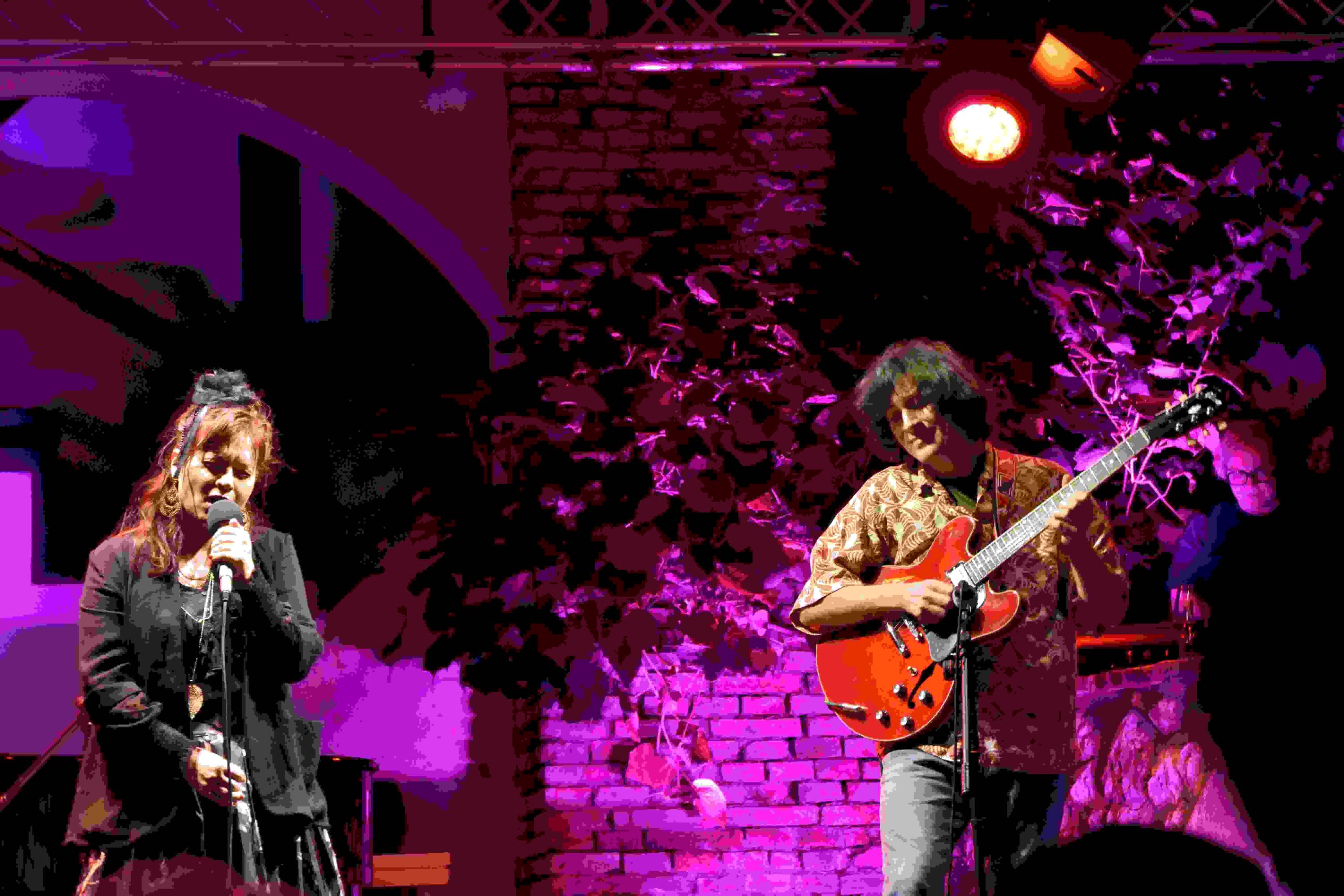
Through her dramatic singing, Simin Tander revitalizes a true musical treasure trove of a country subjected to multiple internal and external aggressions. At times, the language disintegrates into unintelligible imprecations, furious fits and returns to whispers – procedures that were familiar to me from the improvisational experiments of Portuguese singer Maria João. A special encomium for Björn Meyer, a virtuoso of the six-string bass guitar plus its related special effects. His utmost dedication to deep sonorities weaves sound backgrounds of quasi-orchestral magnitude.
A complex artist – oscillating between music and poetry, as well as between his native Lebanon and his adopted country Germany – Rabih Lahoud offered us an entire recital sung in his mother tongue. His vocal inventiveness blended with the procedures of two instrumentalists from his group Masaa – a term that the artist explained as “evening mood.”
Indeed, their pieces created an almost hypnotic flow, especially by revealing traits of the unexpectedly jazzy expressiveness of the Arabic language. It is worth recalling that Lahoud had studied the chants of the Maronite liturgy, the system of Arabic maqams or Aramaic vocal music from an early age, to later become a close disciple of trumpeter Markus Stockhausen’s Eternal Voyage ensemble. However, in the Bran performance the ingenious singer did not limit himself to faithfully taking over the melismatic incantations of his Eastern origins, but interfered them with the torrent of rhythmic-harmonic improvisations compiled by guitarist Matthias Kurth and ever inventive drummer Steffen Roth. The trio’s intense stage action resulted in a captivating show.
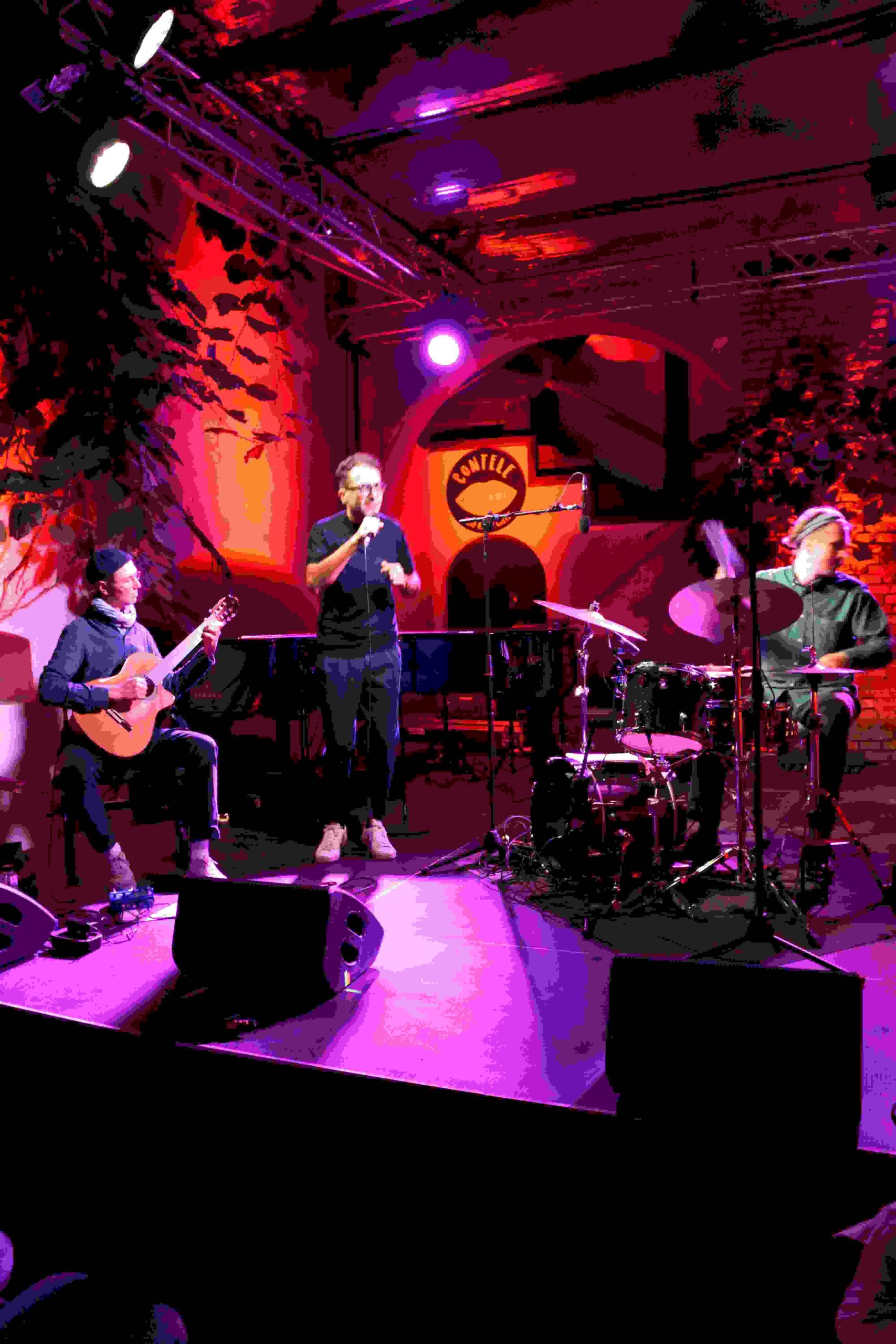
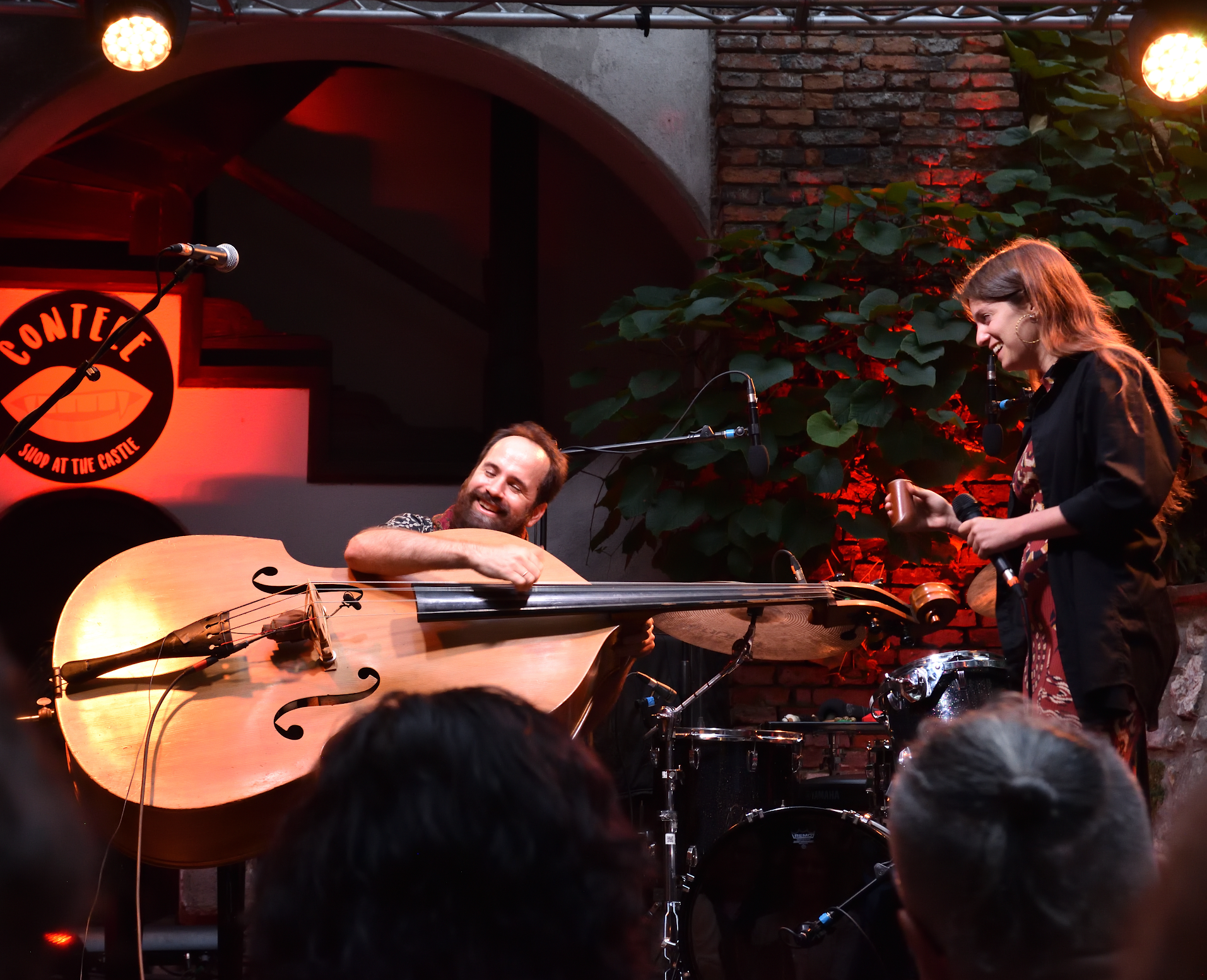
The duo of young Catalans Magalí Sare & Manel Fortià has taken on a quasi-impossible mission: to achieve some sort of an apotheosis of Ibero-American musical Latinity, through a minimum of purely acoustic means. The relationship of Magalí’s feminine voice, of an enveloping plasticity, with the suggestive force inherent in the double bass, is nourished by the playful dispositions of both musicians. Pieces long accepted in the universal heritage – such as the Cuban “Guantanemera” or “Barco Negro,” popularized by the queen of fado, Amália Rodrigues – are dismantled and recomposed with verve, good taste and inherent piety in a spectacular eruption of creativity. At the end, the polyglot singer also intoned a few verses from Tănase’s immortal “Lume, lume.” The audience’s enthusiasm strengthened my conviction that our common origin itself is a guarantee of success for future invitations addressed to jazz musicians from the Latin world!
A sudden downpour forced the organizers to move the last recital from the inner courtyard stage to the castle’s music hall, remodeled a century ago by the architect of Romania’s royal court, the Czech Karel Liman. In that special milieu, where national composer George Enescu himself had performed for Queen Maria, we witnessed an alleviating homage to Armenian vocal traditions, accurately intoned in the original language by Lucine Musaelian (voice and viola da gamba), with due support from the inventive bassist and pianist of Anglo-Argentine ancestry Fred Thomas and British clarinetist Oliver Dover. The latter’s moving modal improvisations denote his assumption of the aesthetics of Djivan Gasparyan, absolute master of the traditional Armenian instrument duduk.
Also noteworthy was the traditional organ concert in the Evangelical Church of Râșnov, performed at the current edition by Austrian composer Stefan Fraunberger. He specialized in composing works for ancient organs of Transylvanian churches, and his inclusion in the festival was possible thanks to the considerable involvement of impresario Emilian Tantana. Established among the leaders of our historic Sibiu Jazz Festival before 1990, and then as a much-appreciated jazz promoter in Austria, Emilian continues to work for the benefit of the public in his country of origin. A behavioral model in agreement with the host team coordinated by Alexandru Prișcu and Paul Tutungiu.
Performance photos by Felix Sebastian Nazarevscky