Pushing Pins: Like it or not, early exposure sticks — red Mary Janes and all
At Earshot Jazz’s annual festival kickoff on October 1, Eugenie Jones stood inside the University of Washington’s Jacob Lawrence Gallery accepting the John Gilbreath Service Excellence Award for her work keeping jazz alive.
She thanked the people whose lives inevitably become entangled in such undertakings: the sleepless nights, missed workouts, marketing, friends and family who absorb the labor surrounding a jazz festival whether or not their names ever appear on a program.
Then she thanked her children.
She acknowledged, with the sort of laugh that somehow contained guilt, sweat and work in its smile, that they had been around all of this “whether they liked it or not.”
That line caught me like a pushpin on the white gallery wall behind me.
Small, almost incidental, but once pushed through, unignorable. Whatever it holds may eventually come down, but the hole remains. I grew up under much the same arrangement. Jazz was never formally introduced to me as something I ought to appreciate; it was simply there, embedded in the architecture of family life. My father practiced. Musicians came over. Rehearsals happened downstairs. Gigs reorganized evenings. I saw the effort and felt the discipline, but when something is always there, you rarely think to name it.
What always fascinated me was that other people came to watch.
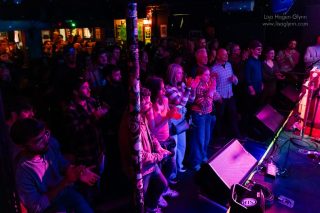
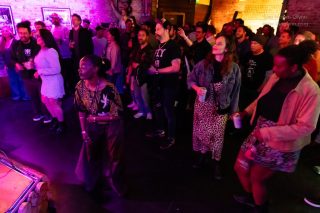
Jazz could be so private downstairs in my family home. One person with an instrument at the beginning of the day, perhaps two by late morning, often three or more by three in the afternoon, practicing something over and over until whatever problem existed between the body and the sound finally gave way. Yet people would leave their own houses and go somewhere specifically to hear my father play, something I could hear him banging around doing downstairs all the time
The gallery was an appropriately peculiar place to arrive at such a realization. It held I will carry you over on my back, the University of Washington’s 2026 Fall MFA exhibition featuring Jayden Dukes, Gaeun Kim, Cameron McGaff and Skye Amber O’Brien. Its installations moved between performance, sound art and found-object sculpture, asking visitors to engage with the room through more than their eyes.
Long before I understood audiences, criticism or cultural value, I understood that something was happening in those rooms that made people want to gather. On October 1, sitting in the Jacob Lawrence Gallery as an adult—a mother, a wife and now an art critic—I understood something about that childhood differently. I had been around it whether I liked it or not, too. And hot damn, am I happy about where I ended up.
Roses filled the tables in lavender, blush, ivory, orange, hot pink and deep maroon. Pink furniture occupied part of the space, while visitors removed their shoes to walk across furry carpet, sand and concrete. The sort of contemporary art that makes a perfectly respectable pair of red Mary Janes feel like part of the installation. Mine had three-inch block heels, accompanied by ivory socks with tiny red flowers. Naturally, I took the shoes off.
A concert hall is architecturally prepared for music; a gallery introduces productive interference. Visual art already occupies the room and makes claims upon attention. Add live jazz and suddenly nothing gets to remain politely in its own sensory category.
Chef’s kiss.
John Gilbreath himself was there while an award bearing his name passed into another set of hands. Shelley Anderson, daughter of Seattle jazz great Ernestine Anderson, was there too, and somehow our conversation turned to my own eight-year-old and had us laughing. Trumpeter Nathan Breedlove introduced himself. Jones, whom I had recently spoken with about producing the Jackson Street Jazz Festival, was being honored for precisely the kind of community work we’d discussed.
And all the while, there was the music.
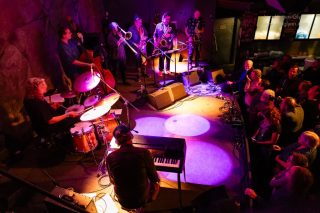
Kate Olson’s KO Quartet made any notion of jazz as a preserved historical object sound faintly ridiculous. With Olson on soprano saxophone, Conner Eisenmenger on trombone, Tim Carey on bass and Evan Woodle on drums, the chordless quartet was alive, muscular and exploratory. Olson commanded attention with the sort of physical conviction that makes critical distance briefly useless. Her phrases pressed against register and pulse; against Eisenmenger’s broader brass sonority, her reed voice gave the frontline friction and conversational elasticity, while Carey and Woodle left enough rhythmic air beneath them for the horns to stretch without losing the ground.
There are musicians one admires from the respectable distance of a notebook, and then there are horn players who make taking orderly notes profoundly inconvenient. Olson is the latter. More importantly, the quartet didn’t illustrate the history being celebrated around it. It demonstrated why that history keeps moving.
Earshot’s thirty-eighth festival was hardly confined to the gallery. Across October, jazz moved through Seattle’s concert halls, neighborhood clubs and classrooms, accompanied by familiar faces who seemed to have discovered a way to be in several places at once. Dr. Stephan Blanford, presiding over his first festival as Earshot’s executive director, appeared at both ends of the calendar with the wide-eyed enthusiasm of someone discovering that everybody had come to his birthday party. Gilbreath, whose more than three decades of leadership helped make such gatherings possible, was still making the rounds. Halynn Blanchard appeared so frequently that I began to suspect Earshot employed several of her. And the festival was teaching people to listen. At a listening workshop, the familiar division between musician and audience became considerably less interesting than the act of paying attention. Listening, after all, is something jazz asks of everybody in the room, whether they’re holding an instrument, a notebook or absolutely nothing.
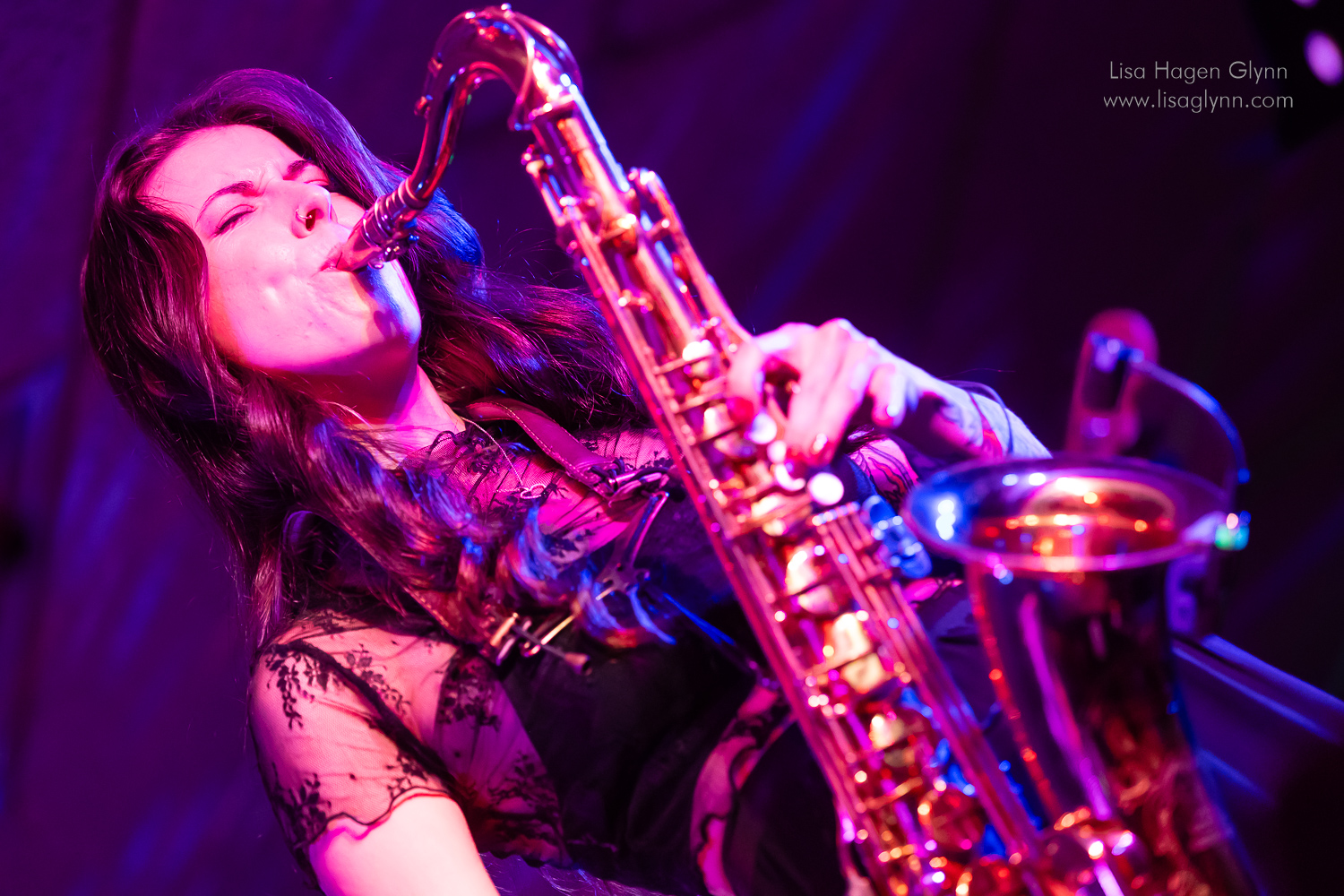
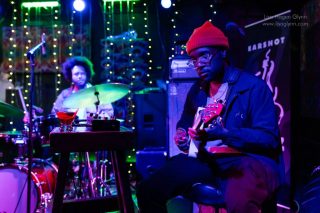
Seattle saxophonist Sidney Hauser’s festival residency offered another glimpse of the city’s musical future. Elsewhere, drummer Corey Fonville and organist Sam Fribush, whom I’d first encountered at Newport in August, appeared at the Sea Monster with guitarist Morgan Burrs. Kassa Overall was among those listening. Musicians, it turns out, attend concerts too.
Looking around, the language jazz journalism uses so frequently—lineage, legacy, preservation, community—began to seem almost comically abstract for something occurring so plainly between actual people. Jazz lineage is not merely a chronology of musicians influencing other musicians. It is social. It passes through teachers and bandstands, certainly, but also through spouses and children, presenters and writers, audiences and family stories, missed workouts and sleepless nights, somebody making the flyer, somebody carrying the case, somebody sitting quietly in the back of the room because their parent brought them along. And I found myself thinking about my son. I cannot think of many better things for a child to be around than jazz. Not because proximity guarantees another musician, critic or lifelong listener.
Inheritance is not replication, and children owe us neither our professions nor our passions.
Jazz offers something more fundamental: an understanding that listening is active, that another person’s voice requires space, that discipline and freedom are not opposites, and that what happens in a room depends upon what everyone in it is willing to bring. This is perhaps the strange bargain at the center of cultural inheritance. Proximity can give you the language, but it cannot compel you to speak it. A family can surround a child with music, history can furnish the vocabulary, and a community can keep opening the door, but eventually the decision to walk back through it belongs to the person who inherited all that proximity. Sometimes, if we’re extraordinarily lucky, our children choose to come back on purpose.
I certainly did.
And I keep thinking about that gallery exhibition, I will carry you over on my back. About Jones’s children, my father’s rehearsals, Olson’s quartet, the workshops, the musicians and audiences who kept turning up across Seattle.
Someone teaches the music. Someone plays it. Someone listens. Someone brings the children along, whether they like it or not.
What gets carried forward is never quite what was handed over. Thank goodness. Someone changes the rhythm, stretches a phrase, takes the music somewhere its previous keeper never imagined. Maybe that is some part of what we’re doing when we write about this music, program it, photograph it, teach it, play it, listen to it and bring our everything along: deciding, again and again, what is worth putting on the wall. What we hang may eventually come down. Someone else may move it, replace it, argue with it or hang something entirely different beside it.
Good.
Someone pushed the first pins into the wall my back now trusts for support, long before I knew enough to notice the holes upon its surface. Something mattered enough to put those holes in the wall.
And as long as I have anything to do with this music, I’ll be pushing pins too. With the rest of us.